Showing posts with label Michael Moorcock. Show all posts

Friday, July 8, 2022

Michael Moorcock Covers From My Youth

My friends and I didn't read Robert E Howard, we didn't read Terry Brooks (other than that first Tolkien pastiche). A lot of us read Tolkien, but not everyone. Michael Moorcock, though, we all read. I think my friend Karl H. told me about Stormbringer first, before I picked up anything by Moorcock.I'm pretty sure he repeated the sword Stormbringer's line to the dead Elric. For him at fourteen or so, it was the epitome of wicked coolness. When I discovered the Lancer copies of The Dreaming City and The Sleeping Sorceress in my dad's vast attic book collection, I was hooked. Gilded battle barges, dragon attacks, demon patrons, and the unholy black sword in the hands of an albino wizard were like nothing else I'd read yet. My dad also had the DAW Dorian Hawkmoon books which were just as mindblowing in their own ways. He also had the first set of Corum books which were even better.

Over the next few years, I plowed through all the core Eternal Champion books. It was the same thing for most of my friends. I remember my buddy Alex R. getting all excited when he discovered (the first person among us) the Count Brass books. 

I'm going to discover how well Stormbringer holds up for a post-middle-age man, but I know it was perfect for a teenager. Elric is all aggrieved moodiness, rebelliousness, and hopelessly romantic - and Romantic. 

The book covers I'm showing below were all books I read multiple times before I finished high school. I've probably read the Corum books the most, finding their Celtic-inspired setting particularly appealing , but even with those, it's been some time since I've read them. The only Moorcock book I've read in recent years was The Eternal Champion. I reviewed it all the way back in 2014 at Black Gate and was left underwhelmed. Nonetheless, I have big hopes for Stormbringer. I'm only a little bit in, and already I feel fourteen again in the best possible way.


Tuesday, June 28, 2016

Awesome Swords & Sorcery Covers II: Eternal Champions

I probably read more Moorcock when I was a teenager than any other writer. I really have no idea how many times I read the various Eternal Champion series. In addition, I read the Dancers at the End of Time series, and various stand alone novels. I particularly liked the Nomads of the Time Stream and their proto-steampunk setting, even if I didn't get all the political, literary, and cultural references. I'm not sure how many books by Moorcock I've read, but I suspect it's around thirty.

I must write, with some sadness, that recent visits to Moorcock's literary landscapes have been a little disappointing. While there's a wild originality to his stories, there's also a sense of playacting that undercuts much of the drama. When Conan growls and swears a mighty oath I buy it. When Elric does the same thing, I don't, and it's because I don't think Moorcock does, let alone can. For all his love of Edgar Rice Burroughs, he's too much of a modern aesthete to really submerge himself in the bloody sinew and gristle of heroic fantasy and let himself go.

While in better hands it wouldn't be a problem, Moorcock seems to have been unwilling to just tell a story. His stories always seem written to make some larger point; humans are destructive and untrustworthy (Corum and The Eternal Champion), the UK's demented and evil (Hawkmoon), and that good and evil are simplistic notions (nearly everything). These are neither deep nor original thoughts, nor does he dig too deeply into them (it's hard to deep thoughts into a slim book when it's already packed with tons of plot). That's not immediately apparent at fifteen, but it is at fifty. There is a thick strand of pedantry that rings too loudly of the waking world, and detracts from the dream world of the story.

Be that as it may, Michael Moorcock's stories still manage to hold a dear place in my heroic fantasy mental landscape. There are few characters more vivid than Elric, Corum, and Dorian Hawkmoon. I still want Jhary-a-Conel's cat, Whiskers, and a friend as loyal as Moonglum. To not read the those three series is to deprive oneself of some of the most original and important writing in heroic fantasy. All those flaws I've found might only be the result of diving into these stories too many times, and becoming too familiar with them, gaining too much insight into the mechanics and the stagecraft. There's so much good stuff in his books that will linger in my mind and outlast any disappointing rereading for a very long time.

Here is a selection of the covers of his books that thrilled me most. Looking at them today, they conjure up not only the stories, but the time when I first read them, discussing them with my friends, and then starting all over and reading them a second and third time.


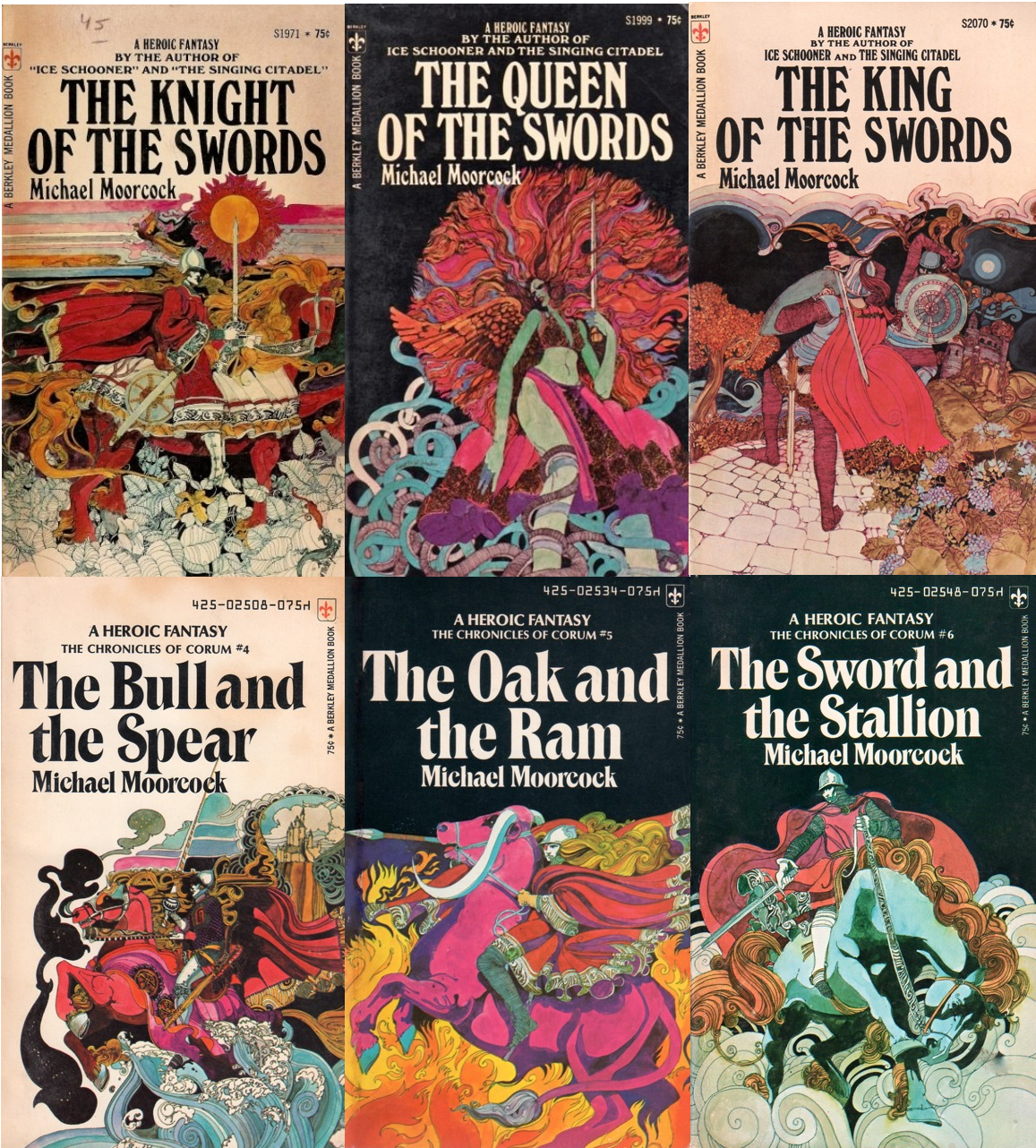
These six covers by American artist David McCall Johnston are my favorite covers of my favorite books by Michael Moorcock. I just plowed through a lengthy and highly disapproving review of the two series over at Ferretbrain. Many of the critic's points mirror my own, but he clearly had much less tolerance for the books' problems. 

I like the contrast of an essentially realistic Corum against stylized backgrounds. It's as if the flesh and blood Prince in the Scarlet Robe is entering a dreamscape, where nothing is quite tangible, be it a field of leaves, waves, flame, or dust. As he spends much of the first trilogy in the ever changing realms of Chaos and the second in magical locales,this seems a reasonable interpretation. 

I'm struck by the color choices. On each cover, red is what draws the eye, whether it's Corum's crimson robe or Xiombarg's Medusa-like hair. The colors are bold but not bright. As much as they draw your eyes in, they aren't harsh or jarring. Again, they have the soft muzziness of a dream, not the razor-clean edges of a photograph. Definitely not covers you see on today's shelves.


Painted by Richard Clifton-Dey, these covers for the First Chronicles of the Runestaff are weird and bad. They are incredibly realistic, but also incredibly stiff and lifeless. The lizard heads on the last two covers appear drawn from real life, but with the tacked on wings and tentacles, they seem as believable as the poor lizards with glued on fins in Irwin Allen's dinosaur movies. Nonetheless, I dug these books, and still have a fondness for them. Sure, he cranked them out like he was on crank, and wrote them for the money, but they are chock full of madness and gonzo images: war flamingos, imperialists all wearing bejewelled animal mask, a withered emperor kept alive in a crystal womb by super science. Pretty awesome stuff. These are editions I first read and the ones that stuck most deeply (and still do) in my brain.


I haven't included the Michael Whelan Elric covers because I already highlighted them a little bit in past posts. I also discovered I was a lot kinder to Moorcock's books than I am today. It's just one those things, I guess. Tastes and attitudes change and there's not much you can do about it, even in as short a time as two years. 

Friday, May 30, 2014

Moorcock, Moorcock, Moorcock, etc.

I delved into my earliest days as a S&S fan this past week, reading for the first time in nearly thirty-five years, Michael Moorcock's The Eternal Champion (as usual, reviewed on Black Gate). The book, while a minor part of the Eternal Champion cycle, and only okay, triggered a whole bunch of memories. Most of the review is dedicated to the place Moorock and his seminal S&S series played in my youth, especially among me and my gaming comrades. Like Chun, these books were unavoidable.

I'm surprised the review didn't generate more comments. I thought at least the older readers would have something to say about Moorcock. In the seventies and the eighties, if you were a fantasy fan it almost went without saying you read at least the Elric books. The Whelan cover for Stormbringer is one of the single most iconic S&S covers bar none. Moorcock's books were part of the warp and woof of heroic fiction.

There's a wild, adventurousness to Moorcock's fantasy. He wrote many of the Eternal Champion books (if I recall right, several of the Hawkmoon books were written in only a few day's time) quickly and the prose isn't always the most beautiful, but it is propulsive and the level of mad, inventiveness has been rarely matched by other S&S authors. The evil Hand of Kwll, Stormbringer and Mournblade, the legions of Granbretan, his books teem with the strange and grotesque. His books are a large part of the reason I'm still reading fantasy today.

I don't think the kids today are reading his books either. They're short and they want the big, fat books. Supposedly, the characterization's weak by today's standards. I think today's standards are simply examples of bloated overwriting. A good writer, and Moorcock is that, can limn a great character and get you into his mind without endless pages and chapters of jib-jab.

I've also read complaints about Moorcock's worldbuilding being flimsy. I'd rather have a one that's alive with chaos and wonder than one where the economics and the lineages of the great houses have all been figured out to the last possible point. Would you really rather have some perfectly constructed world where everything makes sense or Jack Vance's Dying Earth? I'm not saying the well-constructed world doesn't have its place or the ability to come to life (Middle-earth anyone?), but I don't want my fantasy to simply mimic the real world, I want it to deliver me to the realm of fairy or dreams (delightful and nightmarish) and Moorcock delivered that in spades for many years.


Other than my latest rereading of The Eternal Champion, the only Moorcock I've read in recent times are the six Corum books and the first few Elric stories. I think I've read over thirty other books by him. I was glad how well they held up. It's always painful when adolescent pleasures prove disappointing when revived. I wonder how his other books, like The Ice Schooner or the Nomads of the Times Streams series will read today? Maybe this summer I'll find out.


For music I've been digging into some basic rock & roll. I've really been enjoying Rockpile and Dramarama a bunch lately.


Monday, November 26, 2012

More (Moorcock) Covers That Awed Me.

   So many of the books I read as a kid I discovered in cardboard boxes my dad kept in the attic (eleven years after his death most of the paperbacks we essentially co-owned are still there).  I can't remember at what age I started dipping into those boxes but I can remember the feeling of wonder I got when I did.  From Asimov to Zelazny with all stops in between.  There were (are) probably thousands of books in those ancient boxes.  Rockets and wild aliens or brooding swordsmen and bat-winged monsters overhead held the promise of excitement and adventure.  At an early artists like Kelly Freas, and Vincent Di Fate were helping shape my imagination's landscape.
   Like so many readers, I suspect, when presented with a slew of unfamiliar books, we grab the one with the cover that grabs us first.  I don't do that much anymore, but in my youth, boy, oh, boy is that what I did.  Two of the strangest covers I found in the attic were for Lancer Book's Elric books; "The Dreaming City" and "The Sleeping Sorceress".


   These covers, a vibrant collision of psychedelic colors and a weird, almost rotoscope effect were like nothing else (well, maybe the whacked out Ballantine "Lord of the Rings" covers) in the attic.  First there's the girl with the Medusa hair on "Dreaming City" and then the one with the multi-hued afro on "Sleeping Sorceress" to catch your eyes.  Both are staring straight at the reader with alien eyes and arms and wrists held in odd, unnatural poses.  I doubt the dusky-skinned Elric matches anyone's imagined Elric but he and his dragon-winged helmet still demands your attention.  The rainbow plumage of the the winged skull on "Sleeping Sorceress" is beautiful.  The strangeness of the covers turned out to be a perfect match for Moorcock's strange, off-kilter S&S.
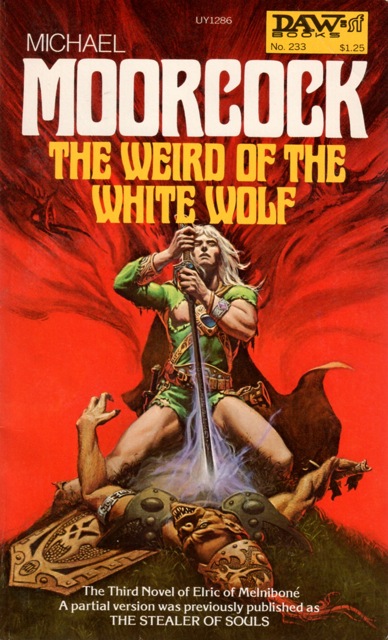
   Fortunately I started reading Elric at the same time DAW started publishing them.  Several trips to Paperback Booksmith in the Staten Island Mall rewarded me with all six original novels.  Michael Whelan's cover art is some of the best in the genre, striving for realistic characters set in believable, fantastic surroundings.  Five of the covers are great (let's all agree the pig-faced corpse ruins "The Weird of the White Wolf").  It's the final one, "Stormbringer", that is a monster.  I don't love the pteranodon dragon in the corner, but, dang, that's a fine, over the top and side-of-the-van worthy Elric.  Stormbringer overhead and Horn of Fate trailing behind, Elric's charging head on at the reader with a perfectly psychotic glint in his bloody red eyes.  I didn't know the apocalyptic story awaiting me inside that book but its cover portended dangerous craziness.  


   I am a little sad that in this day and age of e-books I don't care about covers as much.  I'm not buying in used-book stores, let alone Barnes & Noble, like I used to so the eyecatching ability isn't that relevant.  I know what I'm buying ahead of time with almost every book purchase these days.  I've read the reviews, gotten the recommendations and heard the podcast with the author.  It's the same thing with music.  I can barely recognize the covers of the last MP3 album I bought but the cover of my friend's brother's copy of "In the Court of the Crimson King" is still seared into my mind.  
   I love my e-books and I don't miss the feel of a book and turning pages.  That's because it's the words that I hold dear.  But I will miss the art, and I believe the day's coming when it will pass away into the e-ink ether, one more lost element of analog times.

Saturday, February 25, 2012

Coming Soon To My Mailbox

   Just placed an Amazon order for all sorts of household stuff and whatnot.  Part of the whatnot are several books; Sojan by Michael Moorcock, Battle in the Dawn by Manly Wade Wellman and The Tears of Ishtar by Michael Ehart.  I've never read any of the Sojan stories Moorcock wrote when he was as young as 17.  I have read a story series by Wellman and Ehart and thought they rocked.  In all three cases I pretty much can't wait to get the books in my paws.


Sunday, January 29, 2012

Enter Moorcock in White and Black - The Jade Man's Eyes


   It was bound to happen.  At some point the work of Michael Moorcock, traveler of the multiverse, was going to appear here.  After Howard and Leiber, Moorcock is the third leg of a swords & sorcery tripod for me, and probably the biggest one at that.  I read most of the original Eternal Champion books long before I read much Howard and any Leiber.  Between Dorian Hawkmoon, Prince Corum, Erekose and Elric of Melnibone that's a lot of titles.  (I also read scads of his other work; the man was ludicrously prolific) 
I remember getting excited beyond reason when I bought my copy of "Stormbringer" with the staggeringly cool Michael Whelan cover at the long gone Paperback Booksmith at the Staten Island Mall.  I was thirteen and had been hoarding my money to buy each of the original six novels.  I had read the edited Lancer editions of "The Dreaming City" and "The Sleeping Sorceress" years earlier.  Now I was reading the definitive (for that decade - everything would get rewritten by Moorcock in later years) Elric books as Moorcock had planned and written them.  I was hooked.
   I read as much of Moorcock's swords & sorcery as I could get my hands on.  Tracking down "The Champion of Garathorm" and "The Quest for Tanelorn" proved exceptionally difficult.  But I found them and devoured them.
   Michael Moorcock holds an important place in my heart.  In his short, exotically set books with their baroque universe hopping plots and alien beasts and demons, I encountered the truly strange.  The Young Kingdoms world of the inhuman albino emperor of Melnibone and his cursed black runesword was like nothing I had encountered before.

  The only significant fantasy I'd read before the Elric stories was the Lord of the Rings.  Tolkien makes sense.  His world, with all its beauty and mythic history, is still very much like ours', rooted in a realistic world.  The magic cast, even by the darkest enemy, is subtle and rare.
   The primary setting of the Elric stories is the world of the Young Kingdoms.  It is land of ghoul ridden forests, boiling seas and lands subject to the mutability of Chaos.  Nations are ruled by evil hierophants, twisted beggar kings as well as merchant princes and savage kings.  Magic is thrown with abandon and creatures from numerous plains of existence are summoned on almost every other page.
   And the main character himself was intriguingly strange.  Instead of a noble king-in-waiting like Aragorn, Elric is the demon summoning emperor of an empire of amoral non-human beings.  Bereft of health by his albinism he subsists on rare herbs and drugs.  He is moved to action by curiosity at first and later by revenge.  Much of the time anything noble he does is only a byproduct of nearly selfish actions.  Over time he takes on a nobler cast but his initial darker nature is never far off.
   Over the years I've reread the original six Elric books (Elric of Melnibone, The Sailor on the Seas of Fate, The Weird of the White Wolf, The Vanishing Tower, The Bane of the Black Sword and Stormbringer) several times and some of the novels and stories Moorock added on in the eighties.  I never finished the latter and I should go back and read all of them but late additions like "The Fortress of the Pearl" did not compel me greatly.
   I've been more than thrilled to find the Elric series holds up.  The character of Elric is by turns intriguing, infuriating, thrilling and sympathetic.  And it's all done in six books of under 250 pages apiece.  That's about 1000 pages - that's less than two of Steven Erikson's Malazan books (which I do enjoy).  You just don't really need umpteen thousand pages of supposed character development and plot padding to tell a complex tale.


   "The Jade Man's Eyes" was first published in 1973 as a chapbook from the Unicorn Bookshop and then more widely in Lin Carter's "Flashing Swords #2".  Apparently, Moorcock has said he doesn't remember exactly when he first wrote the story but it might have been as early as 1966.
  In its initial form "The Jade Man's Eyes" tells the tale of Elric and his friend and adventuring companion Moonglum and how they join Duke Avan in his search for the mythic city of R'lin K'ren A'a.  It will take them around the edge of the Boiling Sea, against deadly reptilian beings and into contact with a demon lord and a man cursed with immortality.
  The story is a perfect introduction to the exotic world of Elric.  When first met, Elric and Moonglum are penniless and sleeping on the streets of the wealthy city of Chalal.  When he and Moonglum are threatened with arrest for despoiling the visual beauty the city strives for, Elric makes it quite clear he is willing and able to kill all the guards threatening them.
   The imminent bloodshed is staved off  by the arrival of Duke Avan, native to Chalal and someone who's been searching for Elric for several months.  A renowned adventurer, explorer and collector of antiquities, the Duke desires to find the lost city of  R'lin K'ren A'a.  He needs a sorcerer experienced with adventure and willing to risk great danger.  Saying the "The adventure is to my taste", Elric signs on to Avan's voyage.
   R'lin K'ren A'a is located way up a jungle lined river on the distant and unexplored Western Continent.  Several days up the river they are assaulted by hideous creatures, scaled and walking on legs like wading birds.  To Elric their faces remind him of his own people and he wonders if the Melniboneans were cousins of the creatures or even their descendants.
   Eventually Elric, Moonglum, the Duke and several crewmen reach R'lin K'ren A'a. Each step toward the center of the city reveals There Elric is forced into confrontation with his demonic patron, Arioch.  That confrontation sets in motion even greater events that will come speak to the fate of the world of the Young Kingdoms.
   Later, in the seventies, when DAW published the core six Elric books arranged as intended and without the cuts made by Lancer, Moorcock rewrote "The Jade Man's Eyes".  It became part of the second book, "The Sailor on the Seas of Fate" retitled as "Sailing to the Past" and Moonglum was replaced with Count Smiorgan of the Purple Towns.  Instead of the beggared Elric contemplating his next source of income, Elric is in the midst of a sea voyage across time and space that has set him aside strange yet familiar heroes.

   After the awfulness of the last week's "The Sadness of the Executioner" by Fritz Leiber, "The Jade Man's Eyes" was a nice palate cleansing tonic.  Often Moorcock's swords & sorcery can be burdened down with a weariness and cynicism that seems unwarranted but no so much here.  There's plenty of action, insight into Elric's character and his abilities and history of his world.  Moorcock's sowrds & sorcery roots lay in many places ("Elric of Melnibone is dedicated to Poul Anderson, Fletcher Pratt and Bertolt Brecht) but the lost jungle city, dangerous, monstrous tribesmen and giant statues of gods tropes he employs reflect his strong pulp foundations.  At 16 he was the editor of "Tarzan Adventurers".
   I like the original version of "The Jade Man's Eyes" a little bit better than the rewrite.  It feels tacked on in the novel.  By itself it stands well as just one more adventure in Elric's wanderings across the Young Kingdoms.  Either way, though, it's an exciting story with all the elements of good swords & sorcery; swords, sorcery, monsters and adventure.
   I plan to start rereading the original Elric stories for a later, much more thorough look at Moorcock's most well known creation.  With the current lavishly illustrated Del Rey reprints of the Elric material I hope new generations of swords & sorcery fans are getting to sink their teeth into them.  

Tuesday, June 21, 2011

"Hellsgarde" - C.L. Moore


   C.L. Moore's final story about Jirel, sword wielding, flame-haired, mistress of Joiry, a domain found somewhere in Dark Ages France, is the penultimate story in Sprague de Camp's "Swords and Sorcery" collection.  Despite containing the Conan story, "Shadows in the Moonlight" ("Iron Shadows in the Moon"), and the Fafhrd and Gray Mouser story, "While the Sea King's Away", it's my hands down favorite in the book.

   C.L. Moore, born Catherine Lucille in 1911 in Indianapolis, made her first professional sale hiding behind her sexless initials and introduced her first important character, Northwest Smith, in 1933.  That story, "Shambleau", was published in the November 1933 issue of Weird Tales.  The next year saw the first story about Jirel of Joiry, "Black God's Kiss".  It was printed in Weird Tales as well.

   Over the following five years she wrote five more Jirel stories, including a crossover one with Northwest Smith called "Quest for the Starstone" (and co-written with her husband, Henry Kuttner).  While clearly influenced by Robert E. Howard's near single-handed creation of swords and sorcery, the Jirel stories are closer in mood to horror tales than the the more muscular sword swinging tales of Conan and the fictional followers he inspired.

   "Hellsgarde" describes Jirel's terrifying journey into and subsequent night spent in the long abandoned castle, Hellsgarde.  Two centuries earlier its violent ruler Andred took possession of an unknown but supposedly priceless treasure.  He was set upon almost at once from all sides by numerous men bent on taking it for themselves.  In the end Andred was tortured to death and torn from limb to limb, his blood spilled out onto the floor of his keep.  The treasure, though, he kept hidden and for himself.
  Jirel's undertaking is forced on her by Guy of Garlot.  He has taken several of her retainers hostage and their lives will only be spared if Jirel enters Hellsgarde and retrieves Andred's treasure.  Hellsgarde may only be found at evening and then, sitting in the middle of a marsh dangerous with quicksand, approached only across a long, narrow causeway.  Driven by the knowledge that Guy of Garlot's own keep is impregnable and his demand for the treasure is the only way to save her men, Jirel makes the sunset journey to Hellsgarde.

   Crossing the causeway she sees several ranks of soldiers seemingly in wait for her at the castle gateway.  Only as she nears them can she see they're dead, propped up on their own spears thrust through their throats or torsos or limbs.

  As she works to overcome her fear of the dead men and wonders how and why they came to be their the gate of Hellsgarde opens.  She is greeted by a man she sees as hunchbacked even though his back is straight. Jirel wonders if perhaps her impression is caused by the crookedness of his soul.

  Jirel quickly learns that the crooked man's master, Alaric, is responsible for the deaths of the propped up soldiers.  He informs her that Alaric comes from a distant branch of Andred's family and has come to claim his inheritance in Hellsgarde.  He also ensures Jirel that Alaric will make her most welcome.

  Daring to risk the night at Hellsgarde in order to determine if Alaric has come for and found Andred's lost treasure Jirel enters the castle.  Within she encounters only more strange and unsettling things.  The men who take her horse are more beast than man to her eyes and nothing they do shakes her from that impression.

   Inside the great hall of Hellsgarde, she finds Alaric sitting before a roaring fire.  He is surrounded by a several girls and women, two boys and two great greyhounds.  Behind him is his jester, a dwarf.

   Jirel quickly sees a similarity between Alaric, the doorman and the dwarf.  Though clearly not physically alike all three seem to be twisted by some great burden.  The women's faces seem hollow and the whites of their eyes too white.  Even the dogs seem wrong.  And yet she stays.

  What follows her meeting Alaric is an escalating series of disturbing events.  Like "The Valor of Cappen Varra", "Hellsgarde" doesn't read like a more typical swords and sorcery story.  It reads like a nightmare from the sufferer's perspective.  Jirel's discomfort, fear and determination are all conveyed perfectly by Moore's clear but its precision doesn't detract from the dark dreamlike atmosphere of the story.

  "Hellsgarde" is not like Conan or Fafhrd and the Gray Mouser.  It has little of the ferocious physicality of the former or the humorousness of the latter.  Moore's story has more of the strangeness of the best of Moorcock's swords and sorcery.  Once Jirel crosses the causeway to Hellsgarde you can feel your feet shift under you as you realize the story is bringing you along into the uncertainty that makes up the sleeping world.

Note - All six Jirel stories are available from Paizo in the collection "Black God's Kiss".

Tuesday, September 7, 2010

Beginnings

   In the past I've written and talked about developing some sort of site dedicated to Swords & Sorcery and Heroic Fantasy. It's the stuff I grew up reading in my dad's beat up "Flashing Swords" anthologies and Lancer's illegal "Elric" volumes. I have stacks of beat up Lin Carter pastiches alongside my hard sought Charles R. Saunders' originals and love them both. It fills me with nostalgia but it also gets the adrenalin pumping as I'm reading it.

   My vision of S & S is pretty expansive and not limited to (though totally including) the adventures of neckless barbarians with double bladed axes in chainmail loincloths. I consider (and I know I'm not being particularly original here) the stories of Clark Ashton Smith and Jack Vance's "Dying Earth" as important to the development of the genre as heavy lifting done by Robert E. Howard in the beginning and later by the likes of Fritz Leiber and Michael Moorcock.

   I'm not sure exactly what I'm going to do on this site but if men with thick necks and swords, kidnapped princesses, goateed sorcerers with pointed cowls and lost temples have any appeal, stick around.