Showing posts with label Michael Whelan. Show all posts

Wednesday, November 10, 2021

Gordon Dickson Covers From My Youth

   My dad was a HUUGE Gordon Dickson fan. He easily had thirty novels and short story collections in the attic boxes. As a kid, I read a bunch of them, and well, most of them weren't anything special. Still, they were short and quick and their depictions of competent humans aligned against assorted aliens helped lay the groundwork for my science fiction universe. I know Harlan Ellison was a big fan of his short fiction, so I should probably give some of that a go at some point, but up to now, I haven't.

   I've scavenged all the books from Dickson's Childe Cycle. I've read half of them and, while tinted by age, my memories of them are they were really good. Centered around the mercenaries of the planet Dorsai, he envisioned the series, in addition to the six science fiction novels he finished, as having three historical and three contemporary novels. It would tell the extended history of humanity as it splintered colonizing the stars and was reunified. At his death in 2001, Dickson hadn't finished the final book in the series, Childe, and had never written the non-sci-fi novels. 


   It's an interesting example of evolving covers over the years. Those first two, Dorsai! by Paul Lehr and Necromancer by Jack Gaughan (someone I normally like) are nicely modish, late seventies artwork, but too generic and unmemorable. Now, the next two, both by the mighty Kelly Freas, are a great improvement. Soldier, Ask Not might have one of the best military sci-fi covers around. I've always assumed it depicts the Friendly soldier, Jamethon Black, a character I remember sympathizing with, despite him being something of a humorless scold. Here, dressed all in black and set against a background of stars, he stares forlornly off into the distance, awaiting whatever battle may come. The cover for Tactics of Mistake, featuring the super-tactician, Cletus Grahame, has more than a whiff of evening-time-in-the-Playboy-Mansion-grotto to it, what with him in that intergalactic smoking jacket and orange mood lights playing overhead. I absolutely dig it.

   The last two are just not good. Michael Whelan, one of the book cover greats, has given The Final Encyclopedia the floating man contemplating a tower that no one ever needed. Maybe it's a direct scene from the book, but I don't care, The colors are blah and the scene is just dull. Still, it's way better than what Jim Burns did for The Chantry Guild. 

I'm going to try and do more of these. Old covers, as much as they trigger a burst of nostalgia, also serve as a catalogue of the genre. Clearly, covers fifty-odd years ago were whiter, but they were also pulpier and more exciting. There was no chance you were going to mistake a sci-fi or fantasy book for a romance or some generic airport thriller.

Friday, May 30, 2014

Moorcock, Moorcock, Moorcock, etc.

I delved into my earliest days as a S&S fan this past week, reading for the first time in nearly thirty-five years, Michael Moorcock's The Eternal Champion (as usual, reviewed on Black Gate). The book, while a minor part of the Eternal Champion cycle, and only okay, triggered a whole bunch of memories. Most of the review is dedicated to the place Moorock and his seminal S&S series played in my youth, especially among me and my gaming comrades. Like Chun, these books were unavoidable.

I'm surprised the review didn't generate more comments. I thought at least the older readers would have something to say about Moorcock. In the seventies and the eighties, if you were a fantasy fan it almost went without saying you read at least the Elric books. The Whelan cover for Stormbringer is one of the single most iconic S&S covers bar none. Moorcock's books were part of the warp and woof of heroic fiction.

There's a wild, adventurousness to Moorcock's fantasy. He wrote many of the Eternal Champion books (if I recall right, several of the Hawkmoon books were written in only a few day's time) quickly and the prose isn't always the most beautiful, but it is propulsive and the level of mad, inventiveness has been rarely matched by other S&S authors. The evil Hand of Kwll, Stormbringer and Mournblade, the legions of Granbretan, his books teem with the strange and grotesque. His books are a large part of the reason I'm still reading fantasy today.

I don't think the kids today are reading his books either. They're short and they want the big, fat books. Supposedly, the characterization's weak by today's standards. I think today's standards are simply examples of bloated overwriting. A good writer, and Moorcock is that, can limn a great character and get you into his mind without endless pages and chapters of jib-jab.

I've also read complaints about Moorcock's worldbuilding being flimsy. I'd rather have a one that's alive with chaos and wonder than one where the economics and the lineages of the great houses have all been figured out to the last possible point. Would you really rather have some perfectly constructed world where everything makes sense or Jack Vance's Dying Earth? I'm not saying the well-constructed world doesn't have its place or the ability to come to life (Middle-earth anyone?), but I don't want my fantasy to simply mimic the real world, I want it to deliver me to the realm of fairy or dreams (delightful and nightmarish) and Moorcock delivered that in spades for many years.


Other than my latest rereading of The Eternal Champion, the only Moorcock I've read in recent times are the six Corum books and the first few Elric stories. I think I've read over thirty other books by him. I was glad how well they held up. It's always painful when adolescent pleasures prove disappointing when revived. I wonder how his other books, like The Ice Schooner or the Nomads of the Times Streams series will read today? Maybe this summer I'll find out.


For music I've been digging into some basic rock & roll. I've really been enjoying Rockpile and Dramarama a bunch lately.


Tuesday, July 23, 2013

"Filed Teeth" - First Reading in Glen Cook


 Sometime in 1982 or 1983 my dad, source of so much of my early fantasy and sci-fi reading, picked up a copy of Orson Scott Card's anthology Dragons of Darkness. There are stories between its covers that might be so amazing that they could change my take on fantasy fiction forever.  I don't know and I don't care. That's because the book's first story is "Filed Teeth" by Glen Cook, the first story I ever read by him, and the story that made me a fan of his for life.

  In the first few pages there's adventure and mystery.  A band of soldiers and their employer, Lord Hammer, have just finished a brutal mountain crossing only to find their hoped for rest ruined by the onset of an ice storm. Trudging over the ice the men learn they must march "another eight miles...More if the circle isn't alive."  When I first read that, I was hooked.  Where were they going and what was the circle?

  The narrator, Will, describes a wounded comrade as an old man who should "spend the winters telling the grandkids lies about the El Murid, Civil and Great Eastern Wars". Who was El Murid? What were those wars? From that line it seemed Cook was presenting a fillip of a larger tale and I'm a sucker for that.

  With no other knowledge than that sentence I also believed Cook knew exactly, in detail, what those wars were.  The line wasn't simply a bit of chrome to flesh out a scene but a reference to great events of which "Filed Teeth" was some sort of addendum.
  I was also grabbed by Cook's complete avoidance of any sort of olde tymie dialogue. His characters speak in simple, contemporary English. When Lord Hammer's aide, Fetch addresses the soldiers, it starts like this:
"Hey!  Listen up!. Fetch yelled. "Hey!  I said knock off the tongue music. Got a little proclamation from the boss." "Here it comes.  All-time ass chewing for doing stupid," I said".  
Simple lines like that were revelation after Tolkien and, particularly, his copycats. Cook wasn't the first author to write fantasy like that, but his stories were the first place I sat up and took notice of it. Coupled with his grimier and more mundane approach to the genre it struck me as perfect.  
   By the end of "Filed Teeth", there's been dark and evil forests and a horde of barbarians. Powerful sorceries have been unleashed and mysteries' solutions revealed. Running through it all is a melancholia.  All the men are veterans of the wars mentioned above. Some suffered great losses among friends and family while others found what they believed in undermined and driven into the wilderness. Only later did I learn that's a constant tenor in Cook's stories as men rue the dark things they've done and devastation and betrayals they've witnessed or been subjected to.

  "Filed Teeth" sold me on Glen Cook. I was sold specifically on the need to find the Dread Empire books. I remembered that I'd seen all three rubberbanded together at the late Barrett Book Trader here on Staten Island and dismissed them because of the title deeming it a little cheesy. Now I had to have them. Fortunately, no one else had bought them and soon I was devouring A Shadow of All Night Falling, October's Baby and All Darkness Met.

  I haven't read all his books and still I've read thirty-one. To this day Glen Cook is one of only a few authors I try to buy in hardcover as soon as his books are released (the others are Tim Powers, James Blaylock and Terry Pratchett).

  People can argue about them in comparison to the his next series, The Black Company, all they want. The Dread Empire books are sloppier, less well written, and all manner of things lesser than the Black Company, but they still rock.  For me they hold a special place. The Dread Empire books were grittier and darker than the bulk of the fantasy I had read up to that point. Oh, Moorcock and Wagner got pretty cynical. With Moorcock, though, it often felt like an aesthetic pose. Wagner was probably the closest in sensibilities, but he was writing about an immortal superman. For all their epic adventures, the main characters in the Dread Empire series are mortal and usually driven by mortal desires and fears. Oh, and they are heroes who do noble things, but they have the feet of broken and impure clay.

  In his essay, "Shit Happens in the Creation of Story", in Jason Waltz's Writing Fantasy Heroes, Cook mentions a specific event from the Dread Empire books as an example of the power of story to overwhelm events and characters no matter what the author's intentions. That event, and if you've read them you know what I mean, is still a kick in the gut all these years later.

  Cook was one of the first writers I read for whom no character, no matter how cool or beloved, was sacred.  Anything could happen to anybody at anytime and it did. Unlike many of the dark stuff being written today, it never felt forced or gratuitous. Bad things didn't just happen to remind the reader the world's an unforgiving, pointless crap heap.  Events happened because they flowed naturally from the story.

  As a story, "Filed Teeth" is dynamite. The mystery of Lord Hammer and that of his destination are revealed slowly and skillfully. If you've read the Dread Empire series it's not much of a riddle, but as my introduction to Cook's world, I was as intrigued as the narrator. Set in a forbidding land beyond civilization. and crossed with evil magics, lost cities and the dragon to end all dragons, it's also a spectacularly exciting story for one so suffused with the feeling that legendary times coming to an end.

  Between the Dread Empire and the Black Company series, Glen Cook, I believe, is one of the earliest writers of military fantasy. I find his terse style and shorter books more enjoyable than the giant tomes larded with endless, trivial side plots, visited on us by lots of authors these days (I know, I ride this hobby horse a lot, but c'mon, admit it, too many books are just too long). I'm so grateful to my dad for buying Dragons of Light all those years ago and I'm incredibly grateful to Glen Cook for writing scads of tough, unsentimental fantasy books.

Monday, November 26, 2012

More (Moorcock) Covers That Awed Me.

   So many of the books I read as a kid I discovered in cardboard boxes my dad kept in the attic (eleven years after his death most of the paperbacks we essentially co-owned are still there).  I can't remember at what age I started dipping into those boxes but I can remember the feeling of wonder I got when I did.  From Asimov to Zelazny with all stops in between.  There were (are) probably thousands of books in those ancient boxes.  Rockets and wild aliens or brooding swordsmen and bat-winged monsters overhead held the promise of excitement and adventure.  At an early artists like Kelly Freas, and Vincent Di Fate were helping shape my imagination's landscape.
   Like so many readers, I suspect, when presented with a slew of unfamiliar books, we grab the one with the cover that grabs us first.  I don't do that much anymore, but in my youth, boy, oh, boy is that what I did.  Two of the strangest covers I found in the attic were for Lancer Book's Elric books; "The Dreaming City" and "The Sleeping Sorceress".


   These covers, a vibrant collision of psychedelic colors and a weird, almost rotoscope effect were like nothing else (well, maybe the whacked out Ballantine "Lord of the Rings" covers) in the attic.  First there's the girl with the Medusa hair on "Dreaming City" and then the one with the multi-hued afro on "Sleeping Sorceress" to catch your eyes.  Both are staring straight at the reader with alien eyes and arms and wrists held in odd, unnatural poses.  I doubt the dusky-skinned Elric matches anyone's imagined Elric but he and his dragon-winged helmet still demands your attention.  The rainbow plumage of the the winged skull on "Sleeping Sorceress" is beautiful.  The strangeness of the covers turned out to be a perfect match for Moorcock's strange, off-kilter S&S.
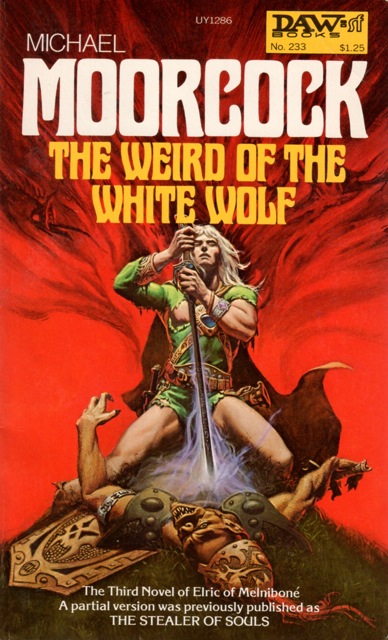
   Fortunately I started reading Elric at the same time DAW started publishing them.  Several trips to Paperback Booksmith in the Staten Island Mall rewarded me with all six original novels.  Michael Whelan's cover art is some of the best in the genre, striving for realistic characters set in believable, fantastic surroundings.  Five of the covers are great (let's all agree the pig-faced corpse ruins "The Weird of the White Wolf").  It's the final one, "Stormbringer", that is a monster.  I don't love the pteranodon dragon in the corner, but, dang, that's a fine, over the top and side-of-the-van worthy Elric.  Stormbringer overhead and Horn of Fate trailing behind, Elric's charging head on at the reader with a perfectly psychotic glint in his bloody red eyes.  I didn't know the apocalyptic story awaiting me inside that book but its cover portended dangerous craziness.  


   I am a little sad that in this day and age of e-books I don't care about covers as much.  I'm not buying in used-book stores, let alone Barnes & Noble, like I used to so the eyecatching ability isn't that relevant.  I know what I'm buying ahead of time with almost every book purchase these days.  I've read the reviews, gotten the recommendations and heard the podcast with the author.  It's the same thing with music.  I can barely recognize the covers of the last MP3 album I bought but the cover of my friend's brother's copy of "In the Court of the Crimson King" is still seared into my mind.  
   I love my e-books and I don't miss the feel of a book and turning pages.  That's because it's the words that I hold dear.  But I will miss the art, and I believe the day's coming when it will pass away into the e-ink ether, one more lost element of analog times.