Showing posts with label Lin Carter. Show all posts

Wednesday, January 27, 2016

Mr. K's Used Books, Music, and More

The luminous Mrs. V. and I just finished a whirlwind road tour of the Deep South (NY to St. Augustine to New Orleans to Vicksburg to Charleston to back home). The last thing we did before beginning what was supposed to be a ten hour plus drive straight through to Staten Island from Charleston, we stopped at Mr. K's Used Books. Wow, I didn't think places like this existed.

Here in NYC, even the paperback book traders are pretty much all gone. Skyrocketing rents and the competition from online sellers and e-books did them in. And, truth be told, most of them aren't too much of a loss. The really good used books stores were far off in Providence and distant parts of New Jersey. Anyone who ever tells you how great the Strand is isn't a person who buys genre books. The store's selection is pretty poor.

Mr. K's is a bookstore dream come true. Its selection in every genre is large and fairly comprehensive. While newer books tend to predominate, each section (especially mysteries) has a decent selection of older books. And the prices are great. Norton Critical Editions (books I pick up used whenever I come across decent copies) sell for $6 and under, a very good price. The prices I saw on mass market editions ranged from as little as $1.50 to $5 for rarer paperback originals. Hardcovers looked to priced the same way.

And, as the title implies, they don't only sell used books. They have a huge selection of CDs, and DVDs. The place is huge to the point of being overwhelming, which is great. 

And despite all my praise, I only made a few purchases (while Mrs. V. picked up a stack of decorating and art books, and mysteries). But what purchases they were. And I only found one of them, my wife found the others.

Mrs. V. spotted both the three-disc The Sabata Trilogy and Lin Carter's Imaginary Worlds. The first was on a shelf of new arrivals and the second was shelved in the literary criticism.

The last thing I got was on a whim. I was skimming the Political Thriller section when the Len Deighton books caught my eye. I've only read a couple of his books (the searing Bomber and the Hitler-Wins-thriller SS-GB), but I've always meant to read The Ipcress File. And now I've got a nice copy for under two bucks. Even if it stinks, who cares?

And that's what I most loved about the old days roaming around used book stores. Of course I wanted to find that perfect (and underpriced) copy of a Ballantine Adult Fantasy book, but it was taking a chance on something completely new. That's a lot harder now and I'm probably never going to spend money on a brand new book without a real serious recommendation from someone I really trust. In the past, I could go to the Book Pit in Red Bank, NJ, and fill up a shopping bag of horror books with cool covers, mysteries that looked nicely off-kilter, and all sorts of classic sci-fi I had never gotten around to reading.


So, if you have the chance, check out Mr. K's. They also have several other locations: Greenville, SC, Asheville, NC, and Johnson City and Oak Ridge, TN. If you get the chance, definitely stop in.

Tuesday, January 6, 2015

Chaosium Mythos Fiction: I Surrender: The Xothic Legend by Lin Carter

I set the folder aside as weariness overcame me.
                             from "Out of the Ages"


That line from one of Lin Carter's own Mythos stories describes exactly how I've come to feel about this book. Try as I might, even though bolstered by editor Robert Price's encouraging introduction to the book and each story, I was unable to work up any real enthusiasm for this book. I've read lots of atrocious Mythos stories over the decades but Lin Carter's are possibly the worst.

Instead of trying to mimic Lovecraft's storytelling style, or even August Derleth's, Lin Carter appears to have reached the conclusion that Cthulhu Mythos stories work best when they consist of long lists of difficult to pronounce names or the titles of fictional compendiums of forbidden lore.

Whether in the Dunsany-flavored "The Red Offering" set in primeval Mu, or the tales set in 1930's California, his approach is the same: throw some names at the reader and then show how every bit of Lovecraft minutiae is connected to every other bit. It's not a winning situation for the reader.

If you're a regular reader of this site or my Black Gate reviews, you know I've been on a bit of a Lin Carter tear of late. I would never argue that he's a lamentably overlooked author, but I was starting to hope he was a better one than I remembered from early encounters with his stories, as well as the general reading public.

While my recent reading of his first two Thongor (his tribute to REH's Conan and ERB's John Carter rolled up in one) was painful, I can tell you the Thongor short stories are great fun. Kellory the Warlock and the first Zanthodon novel were also entertaining. In that light I figured how bad could this be. The answer is, really, really, really bad.

The book's title derives from Xoth, the star from which Cthulhu, his wife, Idh-yaa arrive. Okay, maybe she's only his common-law spouse, but they do have three kids together: Ghatonothoa, Ythogtha, and Zoth-Ommog. In the past they were worshipped by the citizens of Mu but now they are imprisoned. Their interaction with humanity comes through dreams and various servitors, like the wormlike Yuggs. Between them they've got lots and lots of tentacles.

The first batch of stories are tied together in what could have been an interesting way. In "The Red Offering" Carter introduces the Muvian sorcerer, Zanthu. In "The Dweller in the Tomb", an archaeologist goes searching for Zanthu's tomb. The following stories describe the fates of those who come into contact with or followup on the knowledge gleaned from the ancient grave site. Not very original, but interesting. Well, potentially.

That said, I'm throwing in the towel on The Xothic Cycle. I can't handle finishing this book. Even with the prospect of two Robert Price stories towards the end, I just can't do it. 

Instead of telling you why I'll just show you.

From "The Horror in the Gallery"

"Yes," Dr. Armitage nodded. "We have here at the library perhaps the greatest collection of books and documents regarding the Cthulhu mythology that exists in the entire world - probably the finest and most comprehensive collection ever compiled. Beside old Alhazred, we have Prinn and von Juntzt, the Pnakotic Manuscripts, the Norman French version of the Book of Eibon, the Celaeno Fragments, Cultes des Goules, both the R'lyeh Text and the Dhol Chants, the Hsan, the Cabala of Saboth and the Egyptian Black Rites, Porta, Remigius, a manuscript copy of Winters-Hall's translation of The Sussex Manuscript, a few pages of the Invocation to Dagon, and other works as well."

That same sort of list occurs time and time again throughout the half of the book I managed to read. Even "Perchance to Dream", a fun story starring Carter's simulacrum of Seabury Quinn's Jules de Grandin, Anton Zarnak, is marred by lists of names and books:


Zarnak consulted the books in the library. First he looked into a slim, cheaply produced pamphlet which bore the title The Zanthu Tablets and read of Great Ythogtha, the Abomination in the Abyss, imprisoned by the Elder Gods in Yhe. Then he consulted von Juntz, and found the following passage of interest:
Of the Spawn of Cthulhu, only Ythogtha lies prisoned in regions contiguous to sunken R'lyeh, for Yhe was once a province of Mu, and R'lyeh, is not far off the submerged shores of that riven, drowned continent; and Yhe and R'lyeh are close nigh unto each other, along dimensions not numbered among the three we know.


Carter seems constitutionally unable to refrain from explaining everything. There's no room for mystery in these stories. Since he hewed as closely to the story templates created by HPL (ex. find secret lore/object and go mad or discover unknown family connection to Mythos), the conclusions to every story are pretty much clear from the first paragraph. To make this sort of story successful, by which I mean fun to read, you've got to mix it up in the middle. 

That means there needs to be atmosphere or action or creepiness to make your time investment worthwhile. Leave some room for mystery to allow the reader's brain to fill in the gaps with it's own dread fantasies. That doesn't happen. 

So, despite all my best intentions and efforts, I'm walking away from this one. But it's okay. I started Robert Bloch's Mysteries of the Worm and it's already better. Eighteen year old Robert Bloch was a better writer than adult Lin Carter. It's exhilarating to go from one to the other and I'm already feeling better for it.

I'm also going to read the rest of the series in order as Price produced it. He had clear goals and plans in mind when he edited the books. Several of his introductions in The Xothic Legend make references to stories and ideas in earlier collections. Read out of sequence I don't think I'd get the full effect and defense of his theories that Price intended.

For what it's worth, I read the following stories from The Xothic Legend.

The Red Offering - Crypt of Cthulhu #7 - 1982
The Dweller in the Tomb - Dark Things - 1971
The Thing in the Pit - Lost Worlds - 1980
Out of the Ages - Nameless Places - 1975
The Horror in the Gallery - The Disciples of Cthulhu (as "The Terror Out of Time" - 1976
The Winfield Heritance - Weird Tales #3 - 1981
Perchance to Dream - Crypt of Cthulhu #56 - 1988
Strange Manuscript Found in Vermont Woods - Crypt of Cthulhu #54 - 1988
Something in the Moonlight - Weird Tales #2 - 1981

I did not read the poems "Dreams from R'lyeh"

Next Time: Mysteries of the Worm: Early Tales of the Cthulhu Mythos by Robert Bloch

Friday, December 12, 2014

Chaosium Mythos Fiction: Have You Seen the Yellow Sign? : The Hastur Cycle, edited by Robert M. Price

Introduction:

Starting with The Hastur Cycle in 1993, Chaosium Games started printing a series of  Lovecraftian fiction anthologies. Robert M. Price seems to have been in overall charge of the project, with others editing from time to time. Most of the volumes focus on a single aspect of the Mythos, be it a location, like Innsmouth, or a deity, like Cthulhu. Several collect the Mythos fiction of notable authors such as Clark Ashton Smith or Lin Carter. There are several general anthologies in the series, including a reprint of Edward Berglund's seminal Disciples of Cthulhu. You can read the previous entry here.

I'm hoping to reread and review as many of them as possible before I lose too many SAN points. I hope you'll drop by with each new post.

Pt. 1

I love Lovecraft. I love the betentacled, squamous, squelching monsters. I love the brooding atmosphere and cosmic horror. I love the strings of adjectives. I love I share my birthday, August 20th, with him. 

The understandable debate around the appropriateness of using the Gahan Wilson bust of HPL for the World Fantasy Award doesn't change the centrality of his work to weird fiction. He wasn't alone in introducing cosmic weirdness or non-supernatural evil into horror fiction, but I'd argue he's the most important person to have done so. If vampires and werewolves were proving less frightening in an age of growing secularism and scientific progress, he he shows you how the universe is still a harrowing, psyche shredding place. In his best, scariest stories, man is a speck 


I started reading Lovecraft when I was almost eleven years. The very first story I read was "The Festival." It was the night of the 1977 NYC Blackout and I read it out loud to my friend, Jesse B. who was sleeping over while his parents were out of town. It didn't really scare us but it was creepy enough to make me read the rest of the book, The Shadow Over Innsmouth and Other Stories of Horror published by Scholastic Books( !). 

As an introduction to HPL's work, it was a pretty alright place to star. While it includes weaker stories like "The Transition of Juan Romero" and "Imprisoned With the Pharaohs", it also has the monumental "The Colour Out of Space" and "The Shadow Over Innsmouth." That book made me a fan for life. 


Pt. II


The Hastur Cycle, edited by Robert M. Price, is a good book with some dull stories in it.  That isn't as contradictory as it sounds. For each gem there's a snoozer only worth reading for its place in the development of the Lovecraft Mythos. Price, one of the major contemporary Lovecraftian, scholars lays a marker down in his forward about what he hoped to accomplish in this volume and I believe he makes a pretty good case for himself.

Price makes the claim that Lovecraft's mythos is part of a larger body of work that includes stories that predate his own. The HPL tentpole story in the book is "The Whisperer in Darkness." There are works that inspired Lovecraft by Ambrose Bierce, Robert Chambers, and Arthur Machen. Then there are stories that followed in HPL's wake by the likes of Karl Edward Wagner, August Derleth, and James Blish,

August Derleth wrote to Lovecraft that he should call the emerging shared world of stories The Hastur Mythos. While Price thinks Derleth just wanted to use the name of the god that was starting to loom large in his own stories, it evinces a brief moment of insight on the young author's part. The shared world of tales shouldn't be named after HPL's own creation but one that indicated the Mythos extended before HPL and would continue to beyond him into the future. 

The first two stories, "Haïta the Shepherd" (1891) and "An Inhabitant of Carcosa" (1886) by Ambrose Bierce, introduce some of the names that will become part of the central invented lore concerning the figure of Hastur. In the first, Hastur is a the god worshipped by the titular character. The second is a presented as the transcription of a spirit speaking through a medium. This is where the ruined city of Carcosa is mentioned and Hastur's eventual home, the star Aldebaran, first appears.

I don't have anything to say about the two (very short) tales. Their importance lies in helping inspire the next two stories, Robert W. Chambers' nutzoid "The Repairer of Reputations" (1895) and "The Yellow Sign (1895)." Chambers took character and place names from Bierce and added The King In Yellow, a fictional, decadent play apt to drive its readers mad. Mixing these elements together, there's a hint of reality that only heightens the more disturbing parts of his stories.


"Repairer" is a story told by a man manipulating his way to ruling an alternate 1895 America, replete with state sponsored suicide chambers along Washington Square Park and a German invasion of New Jersey. Or it's mad man with head trauma spinning his delusions into a web of paranoia and murder. 

Whichever it is, that dangerous book, The King in Yellow that sits at the heart of the narrator's tale. This startled the heck out of me when I first read it twenty years ago and it still does today.

"The King in Yellow" is a more straigh forward frightener. A louche artist (and reader of The King in Yellow) living near Washington Square Park, sees a strange man working at a nearby church. Soon his dreams are invaded and things start to go terribly wrong. His relationship with his virginal model starts to go wrong and soon all sorts of unpleasantness occurs.

Chamber's invented book clearly points in the direction of Lovecraft's own tome, the Necronomicon and all the various invented volumes evil lore that followed. Only the barest hints of the contents of the The King in Yellow are given which of course lets the reader's imagination run wild. Just where is Lake Hali and what is the Pallid Mask? What is the Yellow Sign that the narrator is asked if he's fouind? This is a magniicent story that still disturbs more than a century after it was written.


Stealing a line from "Over at the Frankenstein Place" from Rocky Horror, "The River of Night's Dreaming" (first published in Whispers III, 1981), by Karl Edward Wagner, is an excursion into madness, again triggered by The King in Yellow. An escapee from a psychiatric hospital finds herself involved in dark, decadent doings in a old mansion in an abandoned and decaying town. Again, is it real or madness?  I'm a big fan of Wagner's but I never particularly cared for this story. Rereading it in the context Price has created I liked it much more. The descent into despair or madness the protagonist suffers is well portrayed and quite unnerving.

While primarily a science-fiction writer (Cities in Flight, A Case of Conscience) and critic, James Blish, like so many others, was a youthful correspondent with the Old Gent from Providence on matters of horror. Part of a real letter he wrote to Lovecraft, asking if he ever intended to write a complete version of the Necronomicon, forms part of Blish story "More Light (first in Alchemy and Academe, 1970)." It posits that Chambers actually sat down and wrote out The King in Yellow and Lovecraft came into possession of it. A writer named William Atheling (Blish's own real-world pen name) has come into possession of it and he wants his friend to read it.

The contemporary portion of the story is good enough, but, sadly, by attempting what Chambers and Lovecraft never did, in creating large chunks of text for The King in Yellow, the story falls flat. It's neither chilling or disturbing. But I don't think that matters. I don't think it's possible for anyone, even a writer as talented as Blish, to create a play that's able to generate madness.

Arthur Machen's "The Novel of the Black Seal" (1895) seems to have introduced the idea of a race of semi-human beings who live under the earth and are the truth behind stories of the little people and changelings. Machen drew on Margaret Murray's silly theories of pastoral, goddess-worshipping humans who retreated into the the wild spaces of England. Price believes that Machen's story informed Lovecraft's own stories of strange creatures living and lurking behind the legends.

The story is a part of Machen's novel of interwoven tales, The Three Impostors. A young woman, destitute and on the verge of giving up, encounters an eminent scientist. He hires her as his children's governess thereby saving her from despair but also bringing her in to contact with the primal terrors lurking under England's green and pleasant hills. I love this one and it's borne up well after multiple rereadings.

Finally we come to Lovecraft's own "The Whisperer in Darkness (first in Weird Tales, 1931)." It's linked to Bierce's stories by the use of Hastur, though clearly he's no longer a shepherd's god. There are also mentions of the Yellow Sign, the Lake of Hali, and Dunsany's Bethmoora for good measure.

For those who haven't read it, well, you should. It's one of Lovecraft's big ones. While less subtle than I remembered, it still does a great job at creating a feeling of impending isolation and doom as the mysterious being hiding in the Vermont hills take action to prevent their discovery. The ending might seem cliched at this point but the first time I read it I was suitably creeped out.

A professor from Miskatonic University is caught up in a debate over whether strange bodies found in the wake of the Great Flood of 1927 are simply bloated animals or strange beings said to live on isolated hilltops. He is skeptical of any claims of boogie men hiding in the woods. Soon after his argument graces the pages of the newspapers he begins he is receiving letters, and later phonograph records, from a retired academic in Vermont that begin to make him change his mind.

Price makes a strong case, based on the general theme of a hidden race, as well as numerous little tips of the hat to Machen, that Lovecraft's story is "essentially a rewriting, a new version of Machen's."

Reading them back to back, I can see his point. Instead of human throwbacks hiding behinds stories of goblins, it's aether-riding aliens (winged, fungus-crab things from beyond our solar system if you must know) obscured by stories of the Yeti and strange figures moving above the Vermont treetops by night. This (and Robert Bloch's "Notebook Found in a Deserted House") made me more than a little uneasy during my first drive through the Vermont woods decades ago.


Robert Lupoff's "Documents in the Case of Elizabeth Akeley" (first in F&SF, 1982) is a sequel to Lovecraft's "Whisperer." It takes claims made by the antagonists in the earlier story seriously and spins out what might have happened next. It's an interesting spin on things but I found it dull. Dull to the point I had to keep forcing myself to pick the book back up and finish the story. Ultimately, it's pretty much a body-swap love-story mashup that I could've done without.

"The Mine on Yuggoth" is one of Ramsey Campbell's earliest stories, first seeing print in The Inhabitant of the Lake and Less Welcome Tenants (1964) which was published when he was still a teenager. It's not great, but it's not terrible either. There's a verve that I've rarely found in stories by those other pasticheurs, August Derleth and Lin Carter. More of a science-fantasy story than horror, there are still a few very good bits that make it more than worth the fifteen minutes or so it takes to read.

James Wade's "Planetfall on Yuggoth" (HPL, 1972) is about a space mission to Pluto. Lovecraft's fiction exists in the story but it soon becomes clear it was more than just storytelling. Then we discover Ramsey Campbell's stories are more than fiction as well. It's slight, a bit of a goof, and perfectly enjoyable.

Then we get smacked in the face by August Derleth's terrible "The Return of Hastur (Weird Tales, 1939)." It's one of his early Mythos stories and I can't say anything about it except it's awful. Price's introduction includes a letter from Clark Ashton Smith to Derleth advising him how to fix the story. Every bit of advice was rejected and the story suffers for it.

Aside from the whole elemental take on the Mythos he would become infamous stinking up the story, Derleth's characters are never believable. There's barely a moment of suspicion or incredulity about the spooky goings on. Within a few pages people are glibly talking about strange fish-men from Innsmouth and gods and demons. And none of it's scary, or fun, or even very interesting.

It feels like Derleth wanted to fit the disparate bits and pieces of Lovecraft's stories and make it all make sense. Price states that Lovecraft explicitly didn't want everything to make sense: "Lovecraft always explained to correspondents that he did not achieve perfect consistency in his various stories, say, in what each said about Cthulhu or the Necronomicon, for the very good reason that he wanted his shuddery allusions to these eldritch items to reflect the inconsistencies, duplications, and redundancies of actual ancient myth cycles, where, e.g., we find two of three origin tales for the same goddess or shrine."

Things pick up considerably with "The Feaster from Afar" by Joseph Payne Brennan. It was first published in the original Disciples of Cthulhu (1976) but rights issues meant it didn't make Chaosium's reprint. Price was able to snag it for the 2nd edition of The Hastur Cycle.

Again it's set in the "real" world, where Lovecraft exists and is a writer strange stories that turn out to be real. I don't love that conceit, never finding it to work very well. How did HPL write what he did without getting killed right away? Nobody except the narrator or some inbred yokel knows he was telling the truth? Nope, it just doesn't work for me.

On the other hand, the story itself is pretty alright. A successful writer of mid-list historical fiction makes the mistake of going to Lovecraft country to find some peace and quiet so he can work on his next novel. Try to guess what happens to him. Despite it's lack of an original plot, Brennan does a good job with it and the feeling of swiftly encroaching doom is well done.

The Hastur Cycle concludes with a series of poems by Lin Carter. Inspired by Bierce, Chambers, and James Blish's work in "More Light." They're a mess and Price says so as well. Carter was driven by the need to make all the pieces fit together and make sense even more than Derleth. As much as I'm looking forward to reading The Xothic Cycle, Carter's collected Mythos stories, these poems made me dread it a little bit as well.


Pt. III

There are better books in this series than The Hastur Cycle but not many that make Price's case as well as this one. Each step of the way you can see how each story sort of moves on to the next one: Lovecraft builds on Machen and on Chambers who built on Bierce. Wagner looks back to Chambers and Wade looks to Lovecraft and Campbell. The book makes as good a case as possible that the Cthlhu Mythos is something greater and more inclusive than just the stories of HPL.

From the forward:

"In the same way, it seems to me highly misleading to take Lovecraft's stories and myth-concepts as the definitive version and to view Chambers and the others as leading up to it, Derleth and the others as representing a declension from it. Each has its own integrity, its own priority. Lovecraft has his moment upon the stage, but then he is replaced by a new teller of a new version."

When this volume first came out, many of these stories were not familiar to me at all. "Repairer of Reputations" blew me away and still does. It's the same for "The Novel of the Black Seal." I don't totally agree with Price's thesis, but I know he comes back to it again in later volumes. As much as Lovecraft drew on earlier authors I think he was doing something entirely different than them. I also see too many of the later authors as too more concerned with mimicking HPL instead of trying to contribute to a larger, inclusive Mythos. Still, after finishing The Hastur Cycle I admit I'm looking forward to see if I can be swayed to Price's side.

The later, post-HPL stories are a decidedly mixed bag of tentacles and pincers. Several are very early examples of Mythos fiction. Sadly, Derleth's is a perfect example of the bad path taken by many other writers. Explain everything, don't bother to build any sort of atmosphere, then explain everything a second time. It's not good.

Still, if you want to see how this great blobby mass that is the Cthlhu Mythos was influenced and grew, this is a good place to start. The less well known stories were hard to come by in 1993. By pulling them together with several important (and great) ones Price did a great service for Mythos readers. Price's essays are major bits of Mythos scholarship, well worth reading. Definitely get the 2nd edition with "The Feaster from Afar" in it.


Next Time: The Xothic Cycle, The Complete Mythos Fiction of Lin Carter, edited by Robert M. Price.

Saturday, December 6, 2014

Mail Bag

It's been a while since I've mentioned new books bought. So here goes.

This was on sale and I wanted a digital version of Ramsey Campbell's "The Tugging." And there's a Charles Saunder's story in there to boot.


Reading a lot of hardboiled over the past month prompted me to finally get a copy of this. 


I only recently learned of Kersh and the terrific title story. For $1.99 you can't go wrong.


This I borrowed for free from Amazon. I like the Christopher Lee movie based on it, and loved his first novel, A Scent of New-Mown Hay. 


'Cause why not? Great so far.


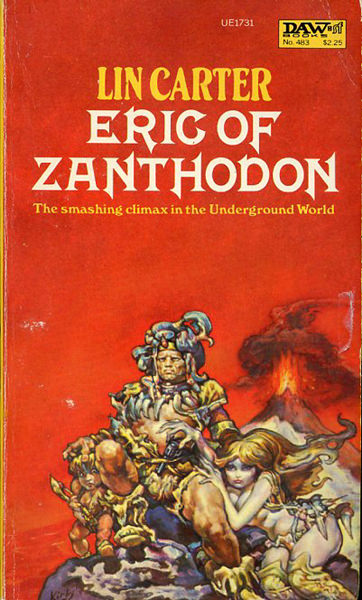
This just popped up on radar last night. For $.99 how could I not buy it even without the gorgeous Josh Kirby covers.

Between this omnibus, the rest of the Thongor books, and the upcoming Xothic Cycle, it looks like I'm going to be having a very Lin Cartery New Year.

Finally, I should have the first Chaosium Mythos Fiction review up this week. The Hastur Cycle, despite some weak stories, has really rekindled hpl, my interest in Mythos stories. This site's gonna become very Cthulhuly for the next few months.

Thursday, November 6, 2014

A Disappointment

I've written a fair amount about Andre Norton's Witch World series at this point. Just this morning my review of Sorceress of the Witch World posted at Black Gate. In the past between this site and Black Gate I've reviewed Spell of the Witch World, Three Against the Witch World, Warlock of the Witch World, and Year of the Unicorn. 

Sorceress concludes the trilogy started in Three and continued in Warlock. I was pretty keyed up to read it. While there's some great stuff in it, including a wizard being used as a power source for a city of cyborgs, it's a disappointment.

All the novels in the series I've read suffer from a stilted style I assume was meant to sound more olde tyme. That's something that doesn't alway work and it totally fails in Sorceress. It makes the heroine sound dull and affectless when she definitely shouldn't.

She's smart as well as clever. Even stripped of her overt magical powers as a consequence of things that happened in Warlock she's still a dangerous foe. But she sounds like she was hit in the head one time too many.

Then there's all the action she's in the middle of. The way she tells it she might as well be describing paint drying. It's just dull, dull, dull.

Still, this is a pretty great series overall. The very first book, Witch World, starts with some terrific world-building and mind-blowing pulp plotting and great action scenes. From there it only gets niftier.

Actually, the books seem to get less pulpy as they go on but I don't hold that agains them. The first two, Witch World and Web of the Witch World are pure science fantasy, complete with ray guns, flying cars, and super computers along with swords and psychic talents.

The later books are more serious and darker. The the stories set in High Hallack focus on the effects of a long, brutal war. War in these stories is less of an excuse for the heroes to be heroic than a terrible thing that must be done to survive. The cost in human lives and human potential is tremendous and is rarely recovered.

For what were initially marketed as YA books, there's a lot of heavy stuff going on. There's genocide, the aftermath of war, opressive gender roles, and lots of violence.

There's a constant atmosphere of loss that permeates much of what I've read so far. There are constant reminders that times were better in the past and the future may not get better. Even when the good guys win it's at terrible costs.

Norton hit on something and then ran with it pretty much for the rest of her life. Unless the rest of the books become amzingly bad I easily see myself finishing this series in the next year or so.

The next book for me is one I'm really looking forward to, The Crystal Gryphon. It features characters from "Dragon Scale Silver" and "The Sword of Unbelief", two excellent stories. I'm not sure when I'll get to that. I've written before that as much as I've like the novels, the short stories are what I've liked best. Probably not until next year.

So my carefully planned reading schedule has gotten knocked out of order already. Next week I'll have my review of Charles R. Saunder's first work of epic fantasy: Abengoni: First Calling. From what I've read, this is a book he's wanted to write for a long time. Thanks to the changed nature of publishing, technology, and the mighty Miltonn Davis, it's finally happening. With Milton behind him I thhink it's a safe bet that the rest of the series will actually get published unlike when DAW and Night Shade were involved.

Then I've got to do the short story reivews. HFQ came out the other day. Without even looking at I feel safe in saying I'm bound to find at least one story I like in it. Plus Swords and Sorcery Magazine's usual two stories and whatever else I can finnd in BCS and the last Fantasy Scroll.

I guess then I'll get back to P. C. Hodgell's Seeker's Mask and Lin Carter's first three Thongor books. And really, if Robert Price is overseeing Carter's bookks why the heck hasn't he let someone make cheap e-books of these things? Very annoying.

Musically, it's been a very Southern time here in Vredenburgh Manor. In anticipation of the Gov't Mule show we're going to in December, I've been listening to a lot of them. Also, lots of Allman Brothers and Derek Trucks Band. Right now I've got a video of Skynrd playing Freebird in England back in 1976. Watching Gaines and Collins play off each other is a blast.


Thursday, October 23, 2014

Brak the Barbarian and Other Things to Come

I've need to start planning a little better beforehand what I'm going to review at Black Gate for some time now. There've been a few weeks where I didn't pick something until the Thursday before. First, it means I avoid longer books, and secondly, whatever the length, I still have to rush through it faster than I'd like.

So, next Tuesday - John Jake's first volume of unabashed REH inspired tales of Brak the Barbarian, called Brak the Barbarian. I've read part of it and it's not that bad. In fact some of it's pretty alright.

After that I'm going to go back to Andre Norton's Witch World series with Sorceress of the Witch World, finishing the trilogy started in Three Against Witch World and continued in Warlock of the Witch World (both reviewed in Black Gate). I'm looking forward to how she ties the trilogy together.


Then it's back to P. C. Hodgell's Kencyrath Cycle and the third volume, Seeker's Mask. Again I reviewed the earlier books,  God Stalk and Dark of the Moon over at Black Gate. I've read this one before and I can tell you it's a great gothic mystery (with ensorcelled chickens and wandering towers).


Finally, I'm going to review the coected Thongor books of too many people's favorite punching bag; Lin Carter. I'll be doing it in two parts: first, Thongor and the Wizard of Lemuria, Thongor and the Dragon City, and Thongor Against the Gods, second, Thongor in the City of Magicians, Thongor at the End of Time, and Thongor Fights the Pirates of Tarakus.


John O'Neil's piece on fan fiction last week over at Black Gate inspired me to revisit one of the possible progenitors of stuff, I've written before, as John very kindly mentions, that Lin Carter was essentially a fan fiction writer who managed to get published. Most of his books are pastiches of his favorites. That means lots of ERB, Leigh Brackett, Lester Dent, and of course, REH and HPL imitations.


Four years ago I reviewed Thongor and the Wizard of Lemuria. It was harsh, and while the book warrants harsh, but a little too flippant. . I've grown a little softer on Carter in the ensuing years. I really dug Young Thongor and Kellory the Warlock's a solid middle-of-the-road book. So I'm going back to it.


I'm also readng a bunch of other stuff, mostly in conjunction with the reading days going on at Howard Andrew Jones' site. That means some hardboiled crime stories for Mondays and Lord Dunsany for Firdays.

So far it's been a lot of fun. I haven't read a lot of crime fiction lately and Jones has put a lot of stuff I have never heard on my radar. I've never read more than a few Dunsany stories at all so this has been a great chance to read them and read some interesting commentary.

So that's what going. Fun reading times ahead!


Tuesday, March 18, 2014

Lin Vrooman Carter

Lin Carter seems to have been in the air with a little more frequency than usual lately. From my review of Kellory the Warlock at Black Gate today, to John C. Wright's piece about James Stoddart on Carter, to 
Raphael Ordoñez's ongoing examination of Imaginary Worlds, Carter's getting a lot of attention these days.

The thing is, except for my review, it's mostly about his editing, not his writing. I get it. I've only dipped a small toe into Carter's writing on a few occasions and most times it's come out all mucky. 

The Xothic Legend Cycle, LC's Lovecraft pastiches can be tough going. Too many read like a Mythos-checklist and lack atmosphere and suspense. The Thongor novels I've read are terrible. But I keep wanting to read more and it's not a case of returning to look at an accident. There's something fun and almost naive about his eagerness to recreate the books he loved reading the most. 

Last year, Charles R. Rutledge recommended Kellory, and I'm grateful for that. It's such a quick read that the flaws don't have enough time to weigh it down. It also isn't a slavish imitation of some other writer. It struck me the same way the recent collection, Young Thongor, did; Carter could write much much better than he did a lot of the time. Maybe if his output was less and he took more time more of his books would have had the quality of these two. But then, maybe Lin Carter wouldn't have had as much fun writing.

Meanwhile, because I've be distracted by reading books for current reviews, I'm still haven't finished Carole McDonnell's wonderfully strange The Constant Tower and Harold Lamb's exciting Swords from the West. The latter makes me wish I had time to play Devil's Horsemen from GMT. 

Not much music this past week, just a little old AC/DC with Bon Scott. I don't dislike Brian Johnson, I just really prefer Scott and the older pre-Mutt Lange sound.


Friday, February 14, 2014

Cool Covers for Books I Never Read


   So these books run a very high risk of stinking but I remain curious. The thing is, my dad was as big a fan as any one could be of Carter's books and had these two in one of those attic boxes I alway mention. and they always caught my eye. The Black Star is probably one of my favorite Frazetta pictures. I've got a lot of stuff I'm hoping to get to this year but I think I need to pull these out of the attic and put them on the TBR stack.


Tuesday, February 11, 2014

Familiar to Millions

   I wrote to the editor of Black Gate that I miss Lin Carter every time I read a batch of short stories. I'm wistful for the days of my youth when every year was saw heroic fantasy anthologies from Carter and a host of other talented editors. Now, I have to make do with the occasional volume like the relatively recent Swords and Dark Magic. If I keep my eyes open I can catch something like Artifacts and Relics but books like that are just all too rare these days. I know I'm always harping on it but I'd just like some reasonably sized books. Whatever.
 My monthly roundup of short stories is live over at
   In keeping with my hope to read more historical adventure fiction I've started Count Bohemund by Alfred Duggan. It's about one of the leaders of the First Crusade and has an effusive foreword by his friend Evelyn Waugh. The next historical book I'm going to read is the Harold Lamb collection Swords from the West edited by Howard Andrew Jones.
  This week I broke out my Britpop albums. Oasis figured heavily in the mix. People can give Noel Gallagher grief for being arrogant and say his lyrics are simplistic. I can't argue with that. The thing is, Oasis set out to be a ROCK BAND. The lyrics are really there to give the crowd something to sign along to instead of just hollering. He's also accused of pilfering too much of his sound from previous musicians. I don't think it's any worse than most. He also knew how to take familiar sounds and forge them into something that could get sixty thousand people singing along.
   What made the band potent were their wall of sound approach to music and their swagger and braggadocio. Noel Gallagher said he wanted their first album to sound like an airplane taking off. From the first note of "Rock and Roll Star" it's clear what he meant. They went off the tracks over the years but their first two albums, Definitely Maybe and (What's the Story) Morning Glory? still shine.
   I've also been listening to Cast, a band formed by John Power from the La's. They were pretty much the exact opposite of Oasis. They're more heartfelt and their lyrics hippieshly cosmic. Their songs exude a positive upbeat vibe that's hard not to appreciate and get you smiling.
Their first album All Change is a blast of fun. I love even their supposed failure of an album, Beetroot. They've reunited but I doubt they'll play the States any time soon. Still, I've got my fingers crossed.


Thursday, March 21, 2013

Mail Bag

Getting my hopes up about the late Lin Carter, I put a order in for all three books in the Chronicle of Kylix cycle.  The third comes recommended by Charles R. Rutledge of Singular Points.  Fingers crossed, people.


   With everybody talking up the Gonji books I had to see what's the deal.  Ordered the first one and started it the other night.  So far, so good.


Wednesday, January 9, 2013

Mailbag (well, 1-click button anyway)

   So that 1-click button on Amazon is a devilishly dangerous.  If something catches my always roving eye or, worse, is on sale - boom - I can just click that button and there's new book on my kindle.  One of the coolest things with e-books is, like when compact discs first started coming out, long out-of-print things are reappearing.  I mean I got Murgunstrumm and Others for about five bucks not hundreds.


   I'm reading the Cave and Carter right now.  So far, "Murgunstrumm" is living up to the hype I've read about it over the years.  It's potent reminded of the editorial brilliance possessed by Karl Edward Wagner.  I'm still only a few pages into "Thongor".  It contains a story by Robert M. Price,  and I've always loved his pastiches of REH and HPL so I've got some hopes for it.  
   "Prince of Thorns" I finished already, and I really don't have anything to say about it that hasn't been said in dozens of other places. Suffice it to say, I read it in two nights and ordered, at full, painful price (I am very, very cheap concerning the price of individual books, especially electric ones), "King of Thorns" within minutes of turning the last pixelated page on my kindle fire.  It brought to mind Moorcock and, perhaps, a more deftly Black Company.  Jorg is one of the most captivating narrators I've encountered in some time.

Saturday, December 22, 2012

Worlds Fantastic and Strange

  Earlier this week, Black Gate's editor, John O'Neil, posted an article about the Bantam Solomon Kane collection, "Skulls in the Stars".  I haven't looked at my copy in years (or any my old Howard books since the Del Rey's came along), but I was immediately reminded of the amazing maps drawn by Tim Kirk.  I dug them out and was happy to find I still like them.
   I'm a fan of maps, real and fantastic.  One of my most treasured books is an pre-WW I atlas my grandfather rescued from a house he was working on.  In its pages the Habsburgs and Hohenzollerns still rule Central Europe and poor Anastasia remains safe in the Winter Palace.  For the time I'm reading I can almost believe a century of time hasn't passed since the book was published.
   Fantasy maps can help bring me into their author's worlds as well as my atlas transports me to pre-war Europe.  Sometimes the maps , sadly are the best part of a book with the names of strange kingdoms and landmarks calling out to me more clearly than their creator's words.
   For me, the best maps are more than just a picture in the front of the book.  They help foster the illusion that the author's world is a real one, one where things unknown lie over the horizon, where mysterious words hint at strange lands and customs.  Maps don't need to be super-detailed with every bit of blank space filled in and city-state named to be successful.  One of the best is below.


  The map from the Ace Conan editions is one of the most important and coolest maps for me.  I stared at the map for some time before I actually read any of the stories (it was my dad's battered, old copy of Conan the Warrior).  While the actual map of Hyboria is fairly lackluster, the superimposed map of the modern world made it mind-blowing for my twelve-year old self.  Suddenly Conan was elevated from a sword swinging warrior to someone who existed in some ancient, "real" time.  It was the first time I'd encountered that conceit in fantasy fiction and it's still one I'm a total sucker for.  Seeing that map I should have been ready for the wondrous mash-up of Cossack, Bantu, medieval and classical cultures that is Howard's Hyboria, but I wasn't.

   Several years later I came across Tim Kirk's rendering of Hyboria sans superimposition.  It's a beautiful map, rendered in thick, emphatic lines with well detailed mountains and I love what I assume is the "Tigress" in the bottom corner.  Without the modern map, though, even with REH's evocative kingdom names it looses some of it wonder.  Still, as I've written, I love Kirk's art.

      "Changa's Safari", by Milton Davis, is set in the lands straddling the Indian Ocean during the 15th century AD.  What I love about this map is that it refocused how I look at a certain part of the world.  In most maps the region's down and off center but here it's the focus of everything.
   One of Davis' goals with swords & soul is to throw off the usual northern European tropes in fantasy and create African ones.  The map pivots a part of the globe I've always sort of seen as secondary and makes it primary.  It left me just waiting to see what Davis would do next to reach his goal.

   
   And sometimes the map's as poor as the story.  From one of Lin Carter's "Thongor" books, this might have been drawn by a child (an untalented and fumble-fingered one).  It's as bereft of character as poor Thongor and Lemuria.  Carter was so caught up in trying to remind readers of John Carter and Conan that he never came up with anything that was uniquely Thongor.  The map's as sketchy and as lifeless as Carter's creation.
 
   Another great possession of mine is J. B. Post's "An Atlas of Fantasy".  It's one of those great seventies books like "Barlowe's Guide to Extraterrestrials" or "The Atlas of Middle-Earth".  Post's book collects maps from myth as well as fantasy and science fiction.  Places like things like Faulkner's Yoknapatawpha County and Al Capp's Lower Slobbovia are also depicted.  It's a beautiful book collecting maps of many of my favorite books and stories alongside others completely unfamiliar to me.  If you like maps it's worth finding.
   All this being said, books don't need maps.  Being forced to couple the author's words with my own imagination to conjure up an image of the geographical layout can be far more satisfying than just looking at a picture.  A poor map can undercut whatever success the author's had working his/her magic in my brain.  The map in "The Sword of Shannara" springs to mind (and we can argue the merits of Terry Brooks some other day, but I readily admit to having a fairly unwarranted soft spot for at least the first batch of his books).  It's flatter and less interesting than any of his prose.
   I know there's a map of Jack Vance's "Undying Earth" out there but I don't need or want it.  It presents definite, concrete borders for a world that should only exist in Vance's fever-dream writing.
   So what do you think?  Do you like them or find them a hindrance to your own imaginations?  What are your favorite and most hated?