Showing posts with label hpl. Show all posts

Tuesday, August 9, 2022

Lovecraft Covers

 The first time I saw H.P. Lovecraft's name was in an advertisement in Creepy Magazine for a series of books. I had no idea who he was or what he wrote, but the freakish looking covers by John Holmes were nuts. It would be several years before I read anything by him, but Holmes' covers stuck with me. I'd later end up picking up most of them along with almost any other Lovecraftian collection I could get my hands on. 

I'm on a bit of a Lovecraftian roll right now. I wrote about Lord Dunsany's At the Edge of the World for Tales from the Magician's Skull. That inspired me to pick up HPL's The Dream Quest of Unknown Kadath for the first time in ages. Simultaneously, to celebrate my shared birthday with HPL, I'm revisiting the very first collection of his stories I ever read; The Shadow Over Innsmouth and Other Stories of Horror published by Scholastic Books of all people. This leads me right to another display of Lovecraftian covers, so here you go.


These first two are August Derleth's Lovecraftian anthology, Tales of the Cthulhu Mythos (1969), broken into two parts. Alongside several Lovecraft originals, there are terrific stories by Robert Block, Brian Lumley, and Frank Belknap Long. Finding these two books at an early age (12 or 13), set me off on a hunt for as many Mythos writers as I could possibly get my hands on. 


Even in the beginning, I was less than fond of August Derleth's efforts at Mythos tale-telling. Not as poor as Lin Carter's, but he never really had the feel for the stuff. His best ones are those that eschew New England and use his own Midwestern environs instead and those aren't here.


These are the original Arkham house omnibuses of Lovecraft's fiction. With the first three covers by Lee Brown Coye and the last by Gahan Wilson, these are a pulp reader's delight. My local library had the first three (which still impresses the heck out of me!) and were the ones I always wanted to own myself. That was not to be. 


These 1980s covers by Raymond Bayless are the ones I ended up with on my shelves. I bought all four on my first book run to Providence back in the mid-nineties. They're fine enough, but a little too meh for my tastes. They do have S.T. Joshi's introductions and, as much as he can be irritating at times, these are incredibly valuable and more than worth your time.


Tony Patrick's covers are not to my taste at all. They appear to have been released around 2001. While they're the current versions, with the slowing collapse of Arkham House, I wonder if there'll ever be another series.


And here it is, where it all began for me on the night of the Great Blackout in 1977. While it's got some lesser tales, it also has The Colour Out of Space and The Shadow Over Innsmouth. 


Sunday, March 17, 2019

Not Five of My Favorite Horror Books

A few weeks ago in a post entitled simply "Horror," Howard Andrew Jones asked what's the pleasure derived from the genre. Here's part of what I wrote in response:

   Pleasure might not be the right word, but I do enjoy the chills I get from a good horror tale. Some of us just like being scared, though perhaps only because we know it’s not real. I don’t want to experience real fear, but I do like a good fright or extended moment of haunting spookiness. Even the best horror isn’t fundamentally different from a jump scare. The trick someone like M.R. James or Laird Barron pulls off is fooling you long and well enough in to believing it’s something more than just a man in a mask screaming “Boo!”
   I’m also pulled in (and impressed) by the ability of good horror to make me feel uneasy and, if only for the length of a book, to believe in something I don’t – i.e. spooks and monsters.

We, at least I, want the frisson we get from being alone in the dark thinking something's lurking behind us. There's probably a neurochemical basis for enjoying the sensation of being scared. Jumping in my seat when Michael Myers emerged from the shadows or when Jack Torrance started swinging the roque mallet released something in me that was practically addictive. Call it chills or shivers, whatever you want, great horror produces a tangible effect on me that is oddly enjoyable.

What I don't want is the stomach-churn from torture porn like Cannibal Ferox or The Bighead. They're sadism marketed as entertainment and I don't have a taste for it. It's one thing to get some momentary thrill from non-existent ghosts, it's another to find thrills from humans torturing and murdering other humans, a thing that happens all the time in real life. Disagree if you must, but this sort of horror's not a hell of a lot better than the old car crash version of the National Enquirer. 

But enough pontificating, let's get to the books.

The Haunting of Hill House (1959) by Shirley Jackson

No live organism can continue for long to exist sanely under conditions of absolute reality; even larks and katydids are supposed, by some, to dream. Hill House, not sane, stood by itself against its hills, holding darkness within; it had stood so for eighty years and might stand for eighty more. Within, walls continued upright, bricks met neatly, floors were firm, and doors were sensibly shut; silence lay steadily against the wood and stone of Hill House, and whatever walked there, walked alone.
The Haunting of Hill House's opening paragraph is one of the most memorable and disturbing. We are presented with a house that looks normal, its walls plumb and doors hanging properly, but in its soul it's mad. The story that unfolds revolves around a question of sanity: is it the house or poor Eleanor Vance that is insane.

Without a doubt, this is my favorite haunted house book. Eleanor Vance joins an expedition to the infamous Hill House led by parapsychic researcher Dr. Montague. Inspired by the Society for Psychical Research's investigation of the Borley Rectory and other such studies, Jackson's story brings a disparate group of characters together to investigate the supposedly haunted mansion under scientific guidelines. It's something other books and movies have done since, but none with as much beautiful darkness and atmosphere. 

The first film of the book, The Haunting (1963) is the best haunted house movie, while the second, also called The Haunting (1999), is one of the worst. The first captures the unsettling atmosphere of the Jackson's novel while the second is overblown and features misplaced and extravagant special effects. The recent Netflix show, The Haunting of Hill House (2018) is inspired by the book but is not really based on it. It is, however, close to being very good.

The Shining (1977) by Stephen King


And in the bug, which moved upward more surely on the gentler grade, he kept looking out between them as the road unwound, affording occasional glimpses of the Overlook Hotel, its massive bank of westward-looking windows reflecting back the sun. It was the place he had seen in the midst of the blizzard, the dark and booming place where some hideously familiar figure sought him down long corridors carpeted with jungle. The place Tony had warned him against. It was here. It was here. Whatever Redrum was, it was here.

The first of the Overlook Hotel, the dark heart of The Shining is from the perspective of five-year old Danny Torrance. For those unaware of the book's basic setup, Jack Torrance, a recovered alcoholic with rage issue, is hired to be the winter caretaker for the hotel, a giant edifice located up in the Colorado Rockies. The place has a bad history (a previous caretaker took an axe to his family before killing himself most notably), but Jack needs the job and is hoping to use the isolation to help him get his novel done.

There's a lot less of the subtle atmospherics of Jackson's book, with King going for more in-your-face violence. Still, it works well at making you believe the Overlook is infested with haunts and foul secrets. I like a lot of King's books, but few still affect me as well as this one, It can still give me shivers reading it late at night with the lights turned low. Jack's fall into madness is also a lot more moving to me past middle-age then when I was a teenager.

I've read a lot of Stephen King's books and this one still strikes me as the most successful and the closest he's come to perfection. Right after the success of this book it's as if he never got edited again. The Stand and It are beloved by millions, but I see them as bloated and soggy. There isn't a wasted or extra word in The Shining. As good as many of his later novels are, very few of them are as tightly plotted and written as this one.

If you've seen Stanley Kubrick's 1980 movie, the book might come as a bit of a shock to you. The novel's Torrance senior isn't Jack Nicholson's twitchy, mad-from-the-get-go dry drunk. He's a man who has crawled up from a pit of rage and booze and is fighting hard to stay sober but he's sane, not nuts from the start like Nicholson's portrayal. I don't like the movie, first, as a fan of the book I disliked its lack of textual fidelity, and, secondly, I find Nicholson's performance overwrought and ultimately boring. There's no suspense, just a lunatic waiting for his moment to cut loose.

As much as I dislike Kubrick's movie, King seems to have disliked it even more. In 1997, he personally oversaw the production of a mini-series starring Steven Weber and Rebecca De Mornay. It's as bad as it is faithful to the book, which a whole lot.

Ghost Story (1979) by Peter Straub

What was the worst thing you've ever done? 
I won't tell you that, but I'll tell you the worst thing that ever happened to me ... the most dreadful thing ...

Decades ago, four old men did something awful. Now that sin has come calling for them. While it reads closer to the modern horror of his friend, Stephen King, Straub drew on the classic ghost stories of Nathaniel Hawthorne, Henry James, and M.R. James - to the point he gave two of his main characters their last names. Before starting the novel, he reread much of the classic supernatural tales, from Poe through Lovecraft.

Ghost Story is part of the mass market horror explosion of the seventies and early eighties. In the wake of Ira Levin's Rosemary's Baby (1967), Thomas Tryon's The Other (1971), William Peter Blatty's The Exorcist (1971), horror became a mainstream, marketable genre. Stephen King was the author who made it a monster. With Ghost Story, his third horror novel, it looked as if Straub would join King at the top of the world. Though he did become very successful, he never entered the public consciousness with anything like the ferocity and implacability of King.

Straub never scaled the same popular heights as King. His work is more consciously literary and he kept his production down to human limits. I'm not saying he's better than King, just different and less obviously commercial. I've only read six of Straub's novels versus over twenty of King's.

A lot of King's success is attributable to his deep affection for and engagement with pop culture. His stories are incredibly accessible - that's explicitly not an insult - whereas Straub's a less so. King doesn't occupy the same cultural space he did thirty years ago, but there was a time when everybody I knew had read at two or three books by King.

It's been a decade or more since I've read Ghost Story but it remains a potent part of my mental gallery of horror. Largely a story about telling stories, this is a significant work that seems more forgotten than it should be.

Presumably based on the success of Kubrick's The Shining, Hollywood threw a ton of money and talent at John Irvin's film, Ghost Story (1981). Starring Fred Astaire, Melvyn Douglas, Douglas Fairbanks Jr., John Houseman, I was pretty jazzed to see it when it came out. Unfortunately, it's not good. Aside from ditching much of the book, it looks like a tv-movie. I may not like Kubrick's movie, but it's still important and worth a view, Irvin's isn't.


The Beautiful Thing That Awaits Us All (2013) by Laird Barron


That buffalo charges across the eternal prairie, mad black eye rolling at the photographer. The photographer is Old Scratch's left hand man. Every few seconds the buffalo rumbles past the same tussock, the same tumbleweed, the same bleached skull of its brother or sister. That poor buffalo is Sisyphus without the stone, without the hill, without a larger sense of futility. The beast's hooves are worn to bone. Blood foams at its muzzle. The dumb brute doesn't understand where we are.

But I do.
-CP, Nov. 1925
from "Hand of Glory"

I bought this book, Barron's third collection of stories, for a $1.99 from Amazon. I only learned of it and Laird Barron at all from a post on Black Gate. I will be forever grateful for that post. Rooted in Algernon Blackwood, HPL, and other forebears of the genre, Barron is not only one of the best horror writers today, but he might be one of the best ever.

It's almost insulting to call the stories in this collection Lovecraftian. Yes, there's an original mythos that serves as connective tissue to stories that take place from the early twentieth century to its end. Yes, these are tales of cosmic horror where people learn the things they weren't meant to know. And yes, set largely in the Pacific Northwest, they have the same deep sense of place and history as the old gentleman from Providence's (his portrayal of Washington state's forests left me so unsettled, I found myself getting spooked hiking through Staten Island's paltry woods one dusk). Don't let any of that fool you or discourage you. Barron's stories may not be sui generis, but he writes in his own voice, giving a face to horrors in a new and potent way.

As much as Barron's concerned with the sort of existential dread that HPL was, he's got an equally deep concern for character. Men and women, straight and gay, old and young, Barron subjects all sorts of victims to the horrors of the void and plunges us into their psyches with a surgeon's precision. Character, especially the flaws and fault lines in there souls, are almost as much the focus of his work as the horrors.

I couldn't find the exact line, but there's one in the story "Hallucigenia" in his earlier collection, The Imago Sequence and Other Stories, which made me despair of ever trying to write fiction. In addition to be a superlative spinner of dark tales, he's writer of tremendous gifts (though, I'm finding myself a little disappointed with his newest collection, Swift to Chase (2016)). I don't love every story in A Beautiful Thing, but there's not one that isn't masterfully written and that will not leave dark designs carved in your brain.

The Dunwich Horror and Others by HP Lovecraft (1963)

The most merciful thing in the world, I think, is the inability of the human mind to correlate all its contents. We live on a placid island of ignorance in the midst of black seas of infinity, and it was not meant that we should voyage far. The sciences, each straining in its own direction, have hitherto harmed us little; but some day the piecing together of dissociated knowledge will open up such terrifying vistas of reality, and of our frightful position therein, that we shall either go mad from the revelation or flee from the light into the peace and safety of a new dark age.
from "The Call of Cthulhu"

After Poe, Lovecraft is the first named horror writer I read. By which I mean, though I'd read some children's spooky stories collections, it was Poe, followed by Lovecraft, whom I knew by name and deliberately sought out.
The first HPL story I read was "The Festival." I was ten, almost eleven, and read it out loud to for me and my friend who staying over. It was the night of the great black out of 1977. While it isn't particularly scary, it managed to creep the two of us out. It was spooky enough that I quickly set out tracking down the rest of his stories. I've been a fan ever since.

It's a minor story of Lovecraft's, but it's a good introduction to the thick, almost dreamlike style of much of his work and his fictional universe, where strange, ancient goings-on transpire behind the scenes of legend-haunted New England towns.

This book contains the most essential of HPL's catalogue. Culled from almost twenty years of his writing, they span from his early pulp tales to the great cosmic horror tales his reputation rests on. If this is all you ever read by him, it'll be enough. 

In the Vault • (1925)
Pickman's Model • (1927)
The Rats in the Walls • (1924)
The Outsider • (1926)
The Colour Out of Space • (1927)
The Music of Erich Zann • (1922) 
The Haunter of the Dark • (1936) 
The Picture in the House • (1919)
The Call of Cthulhu • (1928) 
The Dunwich Horror • (1929) 
Cool Air • (1928) 
The Whisperer in Darkness • (1931) 
The Terrible Old Man • (1921) 
The Thing on the Doorstep • (1937) 
The Shadow Over Innsmouth • (1936) 
The Shadow Out of Time • (1936) 

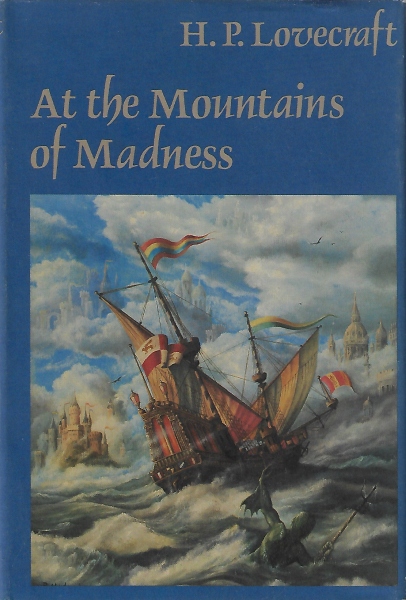
Any self-respecting horror reader owes it to him or herself to have all four original Arkham House HPL collections on the shelf - The Dunwich Horror and Others, At the Mountains of Madness, Dagon and Other Macabre Tales, and The Horror in the Museum and Other Revisions. While I'm glad I have the revised editions done by ST Joshi, I sure wish I had the ones with the original covers by Lee Brown Coye and Gahan Wilson. Whatever, I have a full, hardcover set that I actually bought in Providence, so who am I to complain?


Sunday, March 18, 2018

Creepy John Holmes Mythos Covers

Before I read my first Lovecraft story ("The Festival"), I had seen his books advertised on the back pages of Creepy and Eerie magazines. I had no idea what they were, but it was clear they were horror stories.


When I first picked up HPL, it wasn't in these editions, but an edition of The Shadow Over Innsmouth published by Scholastic Books. These Ballantine collections, though, were all over the place in the late seventies and were among the first I bought myself.

Looking over the contents, they leave out a lot of the major stories, and The Shuttered Room persists in claiming Derleth's stories are based on actual unfinished HPL stories and not mere fragments or jottings in his commonplace book. The two Cthulhu Mythos anthologies, originally released as a single hardcover volume edited by August Derleth, are great. Between them, you get some of the best Mythos fiction. There's "The Hounds of Tindalos," "The Black Stone," "Notebook Found in a Deserted House," and other really good stories.

So, take a moment and take a look at some of the wildest Lovecraft cover art from the late John Holmes.


Tuesday, March 13, 2018

A Night in the Lonesome October by Roger Zelazny and some HPL thoughts


As I was listening to the fine folks at Sanctum Secorum talk about Roger Zelazny's A Night in the Lonesome October (1993) in their excellent podcast, I was prompted to pick the book up myself. It's been several years since last reading it and it seemed time - even if it nowhere near Halloween.

For those of you not in the know, A Night in the Lonesome October (ANitLO) is Zelazny's final solo novel and one of the greatest love letters to HPL, the Universal monsters, and many other touchstones of supernatural horror from days gone by.

Snuff on the prowl
Narrated by the grizzled hound, Snuff, ANitLO, is the wonderfully macabre story of what happens in and near London during the run up to Halloween in 1887. The moon is to be full, and assorted individuals, all with roots in historical or literary characters of a dark nature, will come together on the month's final evening to either open or fight to keep closed a gateway for the Elder Gods to invade the Earth.

If you think that sounds like a dozen other HPL-inspired stories, you're right. But Zelazny isn't just telling some warmed-over story for the umpteenth time. First, there's the homage aspect. Snuff's master is a man called Jack, possessor of, and sometimes possessed by, a great silver, rune-etched knife. Through the fog-choked streets and alleys of London, Jack prowls in search of things to help him on the 31st.

the Count
Some of the players, for what they are doing is called by some the Game, are rooted in historical persons, such as the Mad Russian Monk, Rastov, and the grave robbing Morris and McCab. Others' origins lie in fiction, among them the Good Doctor and the experiment man, and the Count. There's a great article at the Lovecraft eZine that catalogues all the references. Definitely don't spoil some of the book's best surprises by reading the article first.

Each player has a familiar, responsible for certain aspects of the Game. Snuff, for instance is a calculator. Based on the domiciles of the players and other mystical points of reference, he must determine where the gate can be opened come the night of the full moon. He also serves Jack as a companion and watchdog. Each night, for the hour following midnight, the familiars can speak and be understood by their human companions. During the day, the familiars can only speak to each other.

This is my favorite Zelazny book, and that includes the original Amber series and Lord of Light. His writing is clean and clear, while still building up enough atmosphere to bring foggy Victorian London and its suburbs to life. And, while it's a real paean to the genre icons Zelzany grew up with, I grew up on those same things. I watched Basil Rathbone, Boris Karloff and Bela Lugosi on Saturday mornings when I was a kid. I read Lovecraft and true crime books about Jack the Ripper and stories about witches. There's a connection between the heart of this book and me that exceeds anything I encountered in his other works.

Each chapter of this very fun book has an illustration by the mighty Gahan Wilson (whom I just wrote about here). They're brilliantly simple. With just a few lines and some cross-hatching, Wilson adds a nice extra dollop of spookiness to the story. According to the never-wrong Wikipedia, Zelazny had wanted to do something with Wilson all the way back in the late seventies, but it took almost fifteen years for it to happen. Well, it was worth the wait. If you haven't read it yet, don't wait until next Halloween and deprive yourself of an incredibly fun read.

*****************************************

Listening to the Appendix N Book Club podcast about At the Mountains of Madness (with guest, Sanctum Sercorum member, Bob Brinkman), it got me thinking about the difference between Lovecraft's best stories and my favorites. You'd think there'd be no distinction between the two, but there is.

First, let me clarify: what I'm calling my favorites are really the stories that actually kicked me in the gut and stick in my mind the most. Looking back, maybe their impact can be attributed to my age when I read them, but to this day, forty-odd years later, the effect is similar. Here's a list.

"The Outsider"  1926
"Cool Air"         1926
"The Statement of Randolph Carter"  1920
"Rats in the Walls"   1924
"The Lurking Fear"  1923

The big thing that binds these stories together is their EC Comics-style finales, each one a killer last page reveal. In the first it's the identity of the narrator, in "Cool Air" the true nature of Dr. Muñoz's experiments, and so on in the rest. Each tale's lasting, gory, impact, arises from it's closing-page denouement. That final twist of the knife or mallet to the face comes at the end, revealing deeper meaning in and lending deeper resonance to the preceding pages of terror. Lovecraft may have seen himself as standing apart from the pulp horror crowd, but he could write a pure pulp tale with the best of them.

None of them, other than a minor reference here or there, is really connected to HPL's mythos. These are all pretty much standalone horror tales that any number of other horror scribes might have set to paper.

You know, the thing about the big HPL stories - "Call of Cthulhu," "The Dunwich Horror," "The Shadow Out of Time," - is they're pretty damn big on exposition packed with exposition. Reading "The Whisperer in the Darkness," long one of my favorites, I was struck by the lack of real suspense and the surfeit of explanation. It's a great story, with some mind-blowingly cool ideas, but it doesn't possess the slow-building terror I thought it did. The same went for "The Case of Charles Dexter Ward," and "The Dunwich Horror."

Much of the impact of the big stories comes from that great cosmic indifference that defines Lovecraftian fiction. It's a big, existential terror that screams "You are less than insignificant in the face of the nameless chaos that swarms at the heart of the universe." Unfortunately, since I don't believe that, the power of that to scare me is limited. So, while the creepiness of fish-human hybrids, invisible monsters, brains in jars, and such is really creepy, the real effect Lovecraft was going for doesn't work for me.

But, what does work is that nasty, last page disclosure in those stories I listed. They're all early works, written while HPL was still finding his way, discovering a way to express that fear-of-the-void that became the hallmark of his most important stories. They're the ones, though I remember, that still send a chill up my spine in ways the big stories don't.

Saturday, October 31, 2015

Lovecraft for Halloween: Apotheosis: Stories of Human Survival After The Rise of The Elder Gods, edited by Jason Andrew

A few weeks back, I was asked if I'd be interested in reviewing a new Cthlulhu Mythos anthology. My own failed attempt to plow thru a shelf full of Mythos stories last winter inclined me to say no, but then I learned it was a themed collection: all the stories were set after the victory of the monsters. So I said yes.

It's called Apotheosis: Stories of Human Survival After The Rise of The Elder Gods and is edited by Jason Andrew. The book is from Simian Publishing and is available in paperback and e-book forms.

In all my years of (which is exactly 38 years, 3 months, and 17 days - The first HPL story I read was "The Festival" on the night of the NYC Blackout of 1977), I've come across only a few that dared to look at a world under the thumb of the Old Ones and their minions. In fact, the only one that leaps to mind is Basil Cooper's "Shaft Number 247" and it's over thirty years old.

Too often, Mythos stories fall into familiar patterns involving all too familiar props. We all know them: things no man should know, Byakhees, inbred families, evil tomes, etc. There's only so many variations on those things even the best writers can do, so Apotheosis intrigued me even before I cracked the cover.

Between the two covers of this collection of grimmer than the grimmest Warhammer Space Marine, are eighteen tales by authors I am mostly unfamiliar with. On finishing it, I found a few writers I'll keep a weather eye open for in the future and one or two I'll probably pass on.

Apotheosis kicks off with one of the best Mythos stories I have read in a very long time: "The Smiling People" by Andrew Peregrine. In a city surrounded by a high wall built of rubble and bodies, the narrator and his fellow humans live under the constant attention of the titular Smiling People.

They always stand perfectly still, and move quickly when you aren't paying any attention. The most unnerving thing about them though is their faces. They are all the same, blank white ovals, broken only by a huge smiling mouth of sharpened teeth


In "The Pestilence of Pandora Peaslee" by Peter Rawlik, pro-human partisans attempt to overthrow the Yithians. Even though they've turned the Earth into a paradise of clean energy and halted global warming. Its lengthy historical exposition is a little too lengthy, but it doesn't hamper the story too much.


"Daily Grind" posits the place of a psychiatrist under the Old Ones' dominion. The madness of the protagonist's patients loops in and out of her own as she struggles to stay on the right side of her masters. Perhaps one of the blackest tales in the book as instead of tired old monsters it looks at how a person's soul is twisted in a time when the stars are right and all the angles wrong.

L. K. Whyte's "What Songs We Sing" holds out the slenderest reed of hope against the Old Ones, as a woman manages to escape to the countryside.

Adrian Simmons, editor extraordinaire of Heroic Fantasy Quarterly (and a friend), brings on the mayhem with "Dilution Solution." The surviving remnants of humanity live in deep underground warrens. Soldiers augmented with cybernetic enhancements lead raids into the world above. In this tale, one of them sidelined by a failed psych eval is itching to get back into the fray. Unlike the previous tale, this one holds out no hope, only madness.

"Earth Worms" by Cody Goodfellow, editor of last year's Deepest, Darkest Eden, a collection of Clark Ashton Smith-inspired stories, posits the real purpose of humanity: preparing planets for the cockroaches.

A mutated girl, tries to escape the control of Empress Tsan-Chan, in Joshua Reynold's "Eliza." I won't claim to understand exactly what happened in this, but I like the mad mix of cloned Whateleys, magic, and the appearance of the Hounds of Tindalos.

June Violette introduces a Dunsanian tone in "Footprints in the Snow." A young girl promises a new land free of terror to the children of a small town.

"To the Letter" by Jeffrey Fowler is about what a man and his family do when he's drafted by the Fungi from Yuggoth for immortality. Short with a double dosed nasty ending.

Madness, mad gods, and drugs make set the stage for Steve Berman's Namimbian-set "The Balm of Sperrgebiet is the Krokodil." A little vague and hazy for my tastes, but reflective of the narrator's mental predicament.

"Of the Fittest" by Evan Dicken (whom I've reviewed at Black Gate) is another military themed story. In this one, a veteran of Hastur's armies returns from his enlistment to find his friends and neighbors ready to draft him into the resistance. This is another existentially bleak story. Only those able to balance the coldest of equations stand a chance to survive in a world of endless insanity and misery.

"Overcome" by Jason Vanhee makes clear there's as little hope for Christians as anybody else in an Old One run world.

Escape is illusory in "Paradise 2.0" by Glynn Owen Barrass. Again, there is no hope whatever you might think you see or believe.

Madness provides a sort of shield against the advent of the Old Ones to a patient at the Arizona State Mental Hospital in Jeff C. Carter's "The Divine Proportion." Just not enough to survive.

In "The Resistance and the Damned" by Gustavo Bondoni (whom I've also reviewed at Black Gate), the Old Ones taunt a man who has tried to thwart them with murder and insanity.

Jonathan Woodrow's "Twilight of the Gods" assumes the worst of some people and to what depths they will sink to survive under the Old Ones. People can sell other people to the gods who now rule the world from office suites. While I like the idea that the seller gets more money based on much the loss of the particular person they sell costs them, the basic setup feels very out of place in a Mythos setting. 

The closing story is "Venice Burning" by A. C. Wise. The first line, "When R'lyeh rose, it rose everywhere, everywhen." is a curiosity piquing one that is never satisfied with a story that is diffuse and unclear.

For a Mythos story to be successful, for me, it must find a new way to approach material that's been mined for eighty years now. If it can catch the mood, the atmosphere of Lovecraft's not just juggling the bits of timeworn stagecraft around for the umpteenth time. Enough stories in Apotheosis manage that difficult task that I can recommend it to Mythos readers.

For those not already fans of Lovecraftian stories, be prepared for darkness. There are no happy endings, no room for sentiment, nor relief. Not that it's a genre given to those things, but the despair that fills this particular volume is so dense not the least bit of light can escape its pages.

Tuesday, March 24, 2015

Chaosium Mythos Fiction: Mysteries of the Worm (2nd ed.) by Robert Bloch

Baby Bob Bloch
After weeks of delay brought about by travel, cataracts, other obligations, and, above all, laziness, I finally finished Mysteries of the Worm by Robert Bloch. It's name is the English version of Bloch's contribution to the Mythos' library of evil volumes: De Vermis Mysteriis by Ludwig Priin. As edited by Lin Carter, it originally appeared in 1981 from Zebra Books. Both later editions had a few stories added by our hero, Robert Price, and were published by Chaosium. I've read the 2nd edition, depriving myself of four more bits of Mythos writing.

He wrote most of the stories in the collection before he was twenty-two. Some barely rise to the level of story, really being nothing more than a nifty idea but lacking much in the way of plot. Only a few are great, the rest being the work of a novice writer. And I don't care.

There's more atmosphere, more thought, and more originality in almost every one of Bloch's stories than any of those I struggled with in Lin Carter's Xothic Legend anthology. Bloch was still a teenager and there's an intimation that he will be a better storyteller someday. With Carter's stories, it's evident that he had reached his limits.

Pt. I


Robert Bloch (1917-1994) is still, sadly, really only known to the wider public (if at all) as the author of Psycho. Even that laurel is faded as it's Hitchcock's movie that people know best. Apparently he only merits a mention in the recent film, Hitchcock, about the creation of the movie.


What most people don't know is that he started his writing career as a sixteen year old member of the Lovecraft Circle. He had written to HPL in hopes of securing copies of older stories that were no longer available. HPL not only sent him copies, he also encouraged the young Bloch to start writing.

Later, Bloch started writing suspense and horror fiction that was more psychological and less supernatural. That path led to Psycho which ultimaltely seems to have led to Hollywood. There he wrote tons of TV scripts as well as several films. Several of Amicus Productions dynamite horror anthologies were written by Bloch. Asylum remains a favorite of mine. And he never stopped writing original fiction. His last novels, Psycho House and The Jekyll Legacy (co-written with Andre Norton), were published in 1990.

Pt. II
In his introduction, Robert Price makes a defense of the authors who dedicated themselves to systematizing the Lovecraft Mythos, especially Derleth, Carter, and Lumley. The post-Derleth reformers insisted:

the cataloguers have misunderstood what a "mythos" is. They maintain that certain stories by Lovecraft or others may draw on this body of myth, but the Mythos refers to the pseudo-information, not to the stories that draw on it

But there are no real tomes of mystery or actual myths and legends to the Lovecraft Mythos notes Price. The stories we are reading by Carter, Bloch, and others are what really compose the Mythos.


As such, while Bloch's creation, De Vermis Mysteriis by Ludwig Priin doesn't actually exist, Price believes Carter's decision to title the collection after it is perfect, stating "The stories of the Mythos are the Mythos!" It's a line of reasoning I like.

Other than that, there's not much further exploration of the theory Price put forward in The Hastur Cycle, that the "true" Mythos is something that preceded and extended past HPL's own stories. All Carter wanted to do when he created Mysteries of the Worm was to get a bunch of stories he loved by a member of the Lovecraft Circle together in one place.

In his "unauthorized" autobiography, Once Around the Bloch, Bloch wrote that as he had few ideas and no style of his own, when he started he tried to emulate his idol, HPL. And that's what you get in much of Mysteries of the Worm.

These are pulp stories, most written for Weird Tales. You can practically smell the ink and cheap paper as you read them. There's an audio clip of Bloch explaining how he would start with a finale for a story and then work out how he got there. It's easy to imagine him doing that in many of these stories.

In one story, a man kills himself  but the knife he uses is revealed to have the fingerprints of a gigantic ape. In another, a man learns his friend has been strangled by the little monster living on his back. In "Notebook Found in a Deserted House", my favorite in the book, you get exactly what the title describes. All cool ideas that Bloch must have had fun working back to the beginning.

So what to make of the actual stories? For all the rough edges and unsurprising surprises, the earliest stories still have a nice zip to them. While he was trying to emulate his mentor, there's still a leanness to Bloch's prose that's similar to what he would develop as a mature writer.

It's also easy to see that maturity starting to emerge over the course of the book. While Bloch mimicked HPL in the first story, "The Secret in the Tomb", by "The Secret of Sebek" from two and a half years later the narrator is self-aware enough to notice when he find himself talking old-timey all of a sudden. It's not that he's dismissive of HPL's more florid style, but that he's finding his own prosaic one. You can see the taut, more naturalistic prose that's the hallmark of his later thrillers and horror stories coming into being.

Several of the stories are linked, not as direct sequels, but by an Egyptian theme. It first appears in "The Faceless God." Bloch plays with Nyarlathothep as a deity worshipped in ancient Egypt under the priesthood of the dark pharaoh, Nephren-Ka. The latter, as Prices points out, is presented as an evil doppelganger of the monotheist ruler, Akhenaten. Like him, Nephren-Ka was struck from all the histories and monuments, but for vile sins and depravities, not simple heresy.

In the Egyptian stories, Bloch does desert adventure in "The Faceless God", dark secrets in the wild English countryside in "The Brood of Bubastis", and a riff on Poe in "The Secret of Sebek." As in all of Bloch's Mythos stories, the emphasis is on the pulp aspects of the whole enterprise. Bloch admits that his knowledge of historical Egypt was pretty lousy, but really, if there are enough animal-headed mummies and secret tombs, who cares?

Much as some critics go on about the depth of meaning to HPL's stories, what brings most people in I would argue, are the monsters and madmen. Sometimes, readers need to be reminded of this cobbled-together thing's roots.

For all the brooding existential dread that permeates the Mythos, there's also a great sense of play present as well. There's a whole lot of meta-storytelling going on from the very beginning. HPL gave himself and his correspondents nicknames. Lovecraft put some of his friends into the stories and allowed himself to be used by them in turn. In "The Shambler from the Stars" Bloch portrayed HPL as a "mystic dreamer" from New England and killed him off.

Lovecraft got his own back, killing off the Bloch stand in, Robert Blake, in "The Haunter of the Dark." Bloch later wrote "The Shadow from the Steeple," a direct sequel to "Haunter." Both of Bloch's are pretty decent.

It's a kick to witness the literary results of Bloch's and Lovecraft's interaction. They were hoping to write good spook stories, but they were in constant conversation with each other. What Bloch and Lovecraft did, killing each other off, is a lot more enjoyable than Derleth and Carter simply listing all the books from each other's haunted library shelves. 


As good, and as much fun, as Bloch's early endeavors are, it's two of the later stories that are the best in Mysteries. The first of these, and easily my favorite non-HPL Mythos tale, is "Notebook Found in a Deserted House." I first read it in theTales of the Cthulhu  Mythos Vol. 2 with the creepy John Holmes cover. I was probably fourteen when I first read it and was glad to find it held up when I reread it last week.


A boy goes to live with his aunt and uncle in the deep woods. Deep woods where awful things apparently lurk, hiding and waiting for dark and awful purposes. It's not a perfect story, with the juvenile narrator writing in his notebook right up until something smashes down a door (I hope you don't think I'm giving anything away by writing that. This is a Mythos story and you do know how they pretty much all end, right?). But there's a great, creeping feeling of dread and rising fear in the story that's terrific.

The final story, "Terror in Cut-Throat Cove," bridges the gap between Bloch's more traditional Mythos stories and his noir-tinged non-supernatural tales. An American expatriate living on a Caribbean island is approached by an American couple to help out on a dive for a Spanish wreck. Things don't go well.

Pt. III

These are not the finest crafted Mythos stories. The earliest ones suffer from clunky writing and derivative plots. But they breathe, there's life in them that many other Mythos writers never found. Bloch's skills developed quickly, and within a few years he was crafting well-written and clever stories that supply a nice jolt.

Bloch never abandoned his love for HPL's creation. In 1978 he wrote Strange Eons. It's a goofy book that tells of the final rising of dread Cthulhu by weaving together incidents from HPL's own tales. It's not scary or disturbing, but it is a lot of fun. It was published by Whisper Press, an arm of the great and mighty Whispers magazine.

Bloch at the Other End of Life
If you have any interest in Robert Bloch or Mythos fiction, buy yourself a copy of Mysteries of the Worm. I'll probably upgrade my copy to the newest edition in the future. The Hastur Cycle is a collection with a more serious purpose (to prove Price's theory regarding the nature of the Mythos as a body of stories), and several stories that aim for loftier artistic goals than Bloch's, but that leaves that volume a little drier and almost academic compared to this one. This book is just much more fun, and, really, that's why I read these stories.


Next Time: Cthulhu's Heirs: Tales of the Mythos for the New Millennium, edited by Thomas M. K. Stratman