Showing posts with label Cthulhu Mythos. Show all posts

Tuesday, August 9, 2022

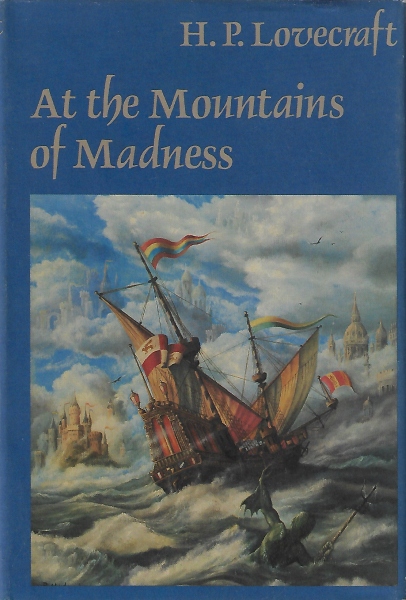
Lovecraft Covers

 The first time I saw H.P. Lovecraft's name was in an advertisement in Creepy Magazine for a series of books. I had no idea who he was or what he wrote, but the freakish looking covers by John Holmes were nuts. It would be several years before I read anything by him, but Holmes' covers stuck with me. I'd later end up picking up most of them along with almost any other Lovecraftian collection I could get my hands on. 

I'm on a bit of a Lovecraftian roll right now. I wrote about Lord Dunsany's At the Edge of the World for Tales from the Magician's Skull. That inspired me to pick up HPL's The Dream Quest of Unknown Kadath for the first time in ages. Simultaneously, to celebrate my shared birthday with HPL, I'm revisiting the very first collection of his stories I ever read; The Shadow Over Innsmouth and Other Stories of Horror published by Scholastic Books of all people. This leads me right to another display of Lovecraftian covers, so here you go.


These first two are August Derleth's Lovecraftian anthology, Tales of the Cthulhu Mythos (1969), broken into two parts. Alongside several Lovecraft originals, there are terrific stories by Robert Block, Brian Lumley, and Frank Belknap Long. Finding these two books at an early age (12 or 13), set me off on a hunt for as many Mythos writers as I could possibly get my hands on. 


Even in the beginning, I was less than fond of August Derleth's efforts at Mythos tale-telling. Not as poor as Lin Carter's, but he never really had the feel for the stuff. His best ones are those that eschew New England and use his own Midwestern environs instead and those aren't here.


These are the original Arkham house omnibuses of Lovecraft's fiction. With the first three covers by Lee Brown Coye and the last by Gahan Wilson, these are a pulp reader's delight. My local library had the first three (which still impresses the heck out of me!) and were the ones I always wanted to own myself. That was not to be. 


These 1980s covers by Raymond Bayless are the ones I ended up with on my shelves. I bought all four on my first book run to Providence back in the mid-nineties. They're fine enough, but a little too meh for my tastes. They do have S.T. Joshi's introductions and, as much as he can be irritating at times, these are incredibly valuable and more than worth your time.


Tony Patrick's covers are not to my taste at all. They appear to have been released around 2001. While they're the current versions, with the slowing collapse of Arkham House, I wonder if there'll ever be another series.


And here it is, where it all began for me on the night of the Great Blackout in 1977. While it's got some lesser tales, it also has The Colour Out of Space and The Shadow Over Innsmouth. 


Tuesday, March 27, 2018

Ramsey Campbell Lovecraft Mythos

Everybody knows (or should know) the story of sixteen year old Ramsey Campbell submitting stories set in Lovecraft Country to August Derleth. Derleth sent them back suggesting he set them in his native England instead of alien New England. Thus Campbell's Sevren Valley was born. Instead of Arkham there's Brichester, for Innsmouth there's Goatswood, and for Kingsport, Temphill. 

The Chaosium published tribute to Campbell's Mythos fiction, Made in Goatswood has none of his early stories. I decided, in that case, I had better go and read them, first, for the fun of it, and then to get a better feel for what the collection authors' were hoping to emulate and memorialize. So, I'm also reading the latest edition of Campbell's first book, The Inhabitant of the Lake and Less Welcome Tenants.

The edition I have (2013, Drugstore Indian Press) includes an introduction by Campbell and his early correspondence with August Derleth. It's fun thinking of Derleth doing what Lovecraft did for him for Campbell. Derleth offered many suggestions that led to Campbell creating his own English setting and new deities for Mythos-inspired fiction. It's interesting to look at how Campbell turned out - one of the most important and revered horror writers - versus how Derleth did - a poor Mythos writer, but a solid editor.

If you haven't read Campbell's pastiches, they're clunky and more about monsters than atmosphere. Nonetheless, they are a bunch of fun. Some are only echoes of stories by HPL, but in others you can already sense his eventual predilection for grotty, urban unease forming.

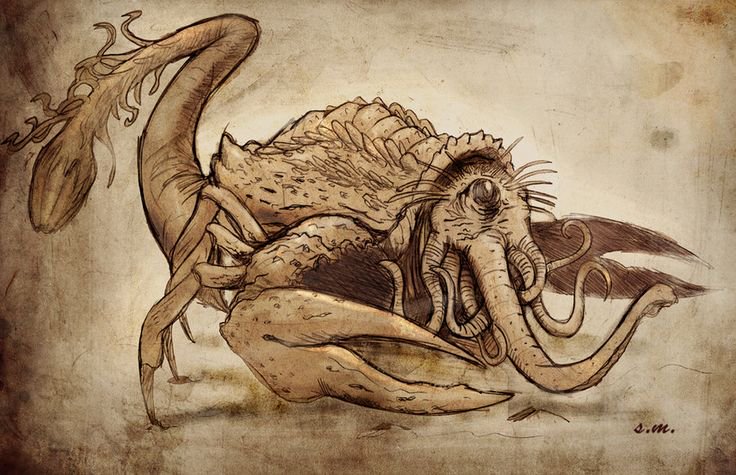
The best thing about them, though, has to be the monsters. They're more intimate than HPL's critters, and what they do to their victims more personal. Where Cthulhu or Yog-Sothoth's kid just step on you, Gla'aki and Eihort gut you up close and you can feel your life seeping away, torturous moment by torturous moment. So, today, I give you monster pictures.

Byatis: "It had but one eye like the Cyclops and had claws like unto a crab. He said also that it had a nose like the elephants...and great serpent-like growths which hung from its face like a beard in the fashion of some sea monster. .." 
from "The Room in the Castle"

Gla'aki: "The centre of each picture was, it was obvious, the being know as Gla'aki. From an oval body protruded countless thin, pointed spines of multicolored metal' at the more rounded end of the oval a circular, thick-lipped mouth formed the centre of a spongy face, from which rose three yellow eyes on thin stalks. Around the underside of the body were many white pyramids, presumably used for locomotion. The diameter of the body must have been about ten feet at its least width."
from "The Inhabitant of the Lake"


Eihort: "Then came pale movement in the well, and something clambered up from the dark, a bloated blanched oval supported on myriad fleshless legs. Eyes formed in the gelatinous oval and stared at him."
        from "Before the Storm"

Y'golonac: "He saw why the shadow on the frosted pane yesterday had been headless, and he screamed. As the desk was thrust aside by the towering naked  figure, on whose surface still hung rags of the tweed suit, Strutt’s last thought was an unbelieving conviction that this was happening because he had read the
Revelations…but before he could scream out his protest his breath was cut off, as the hands descended on his face and the wet red mouths opened in their palms."
        from "Cold Print"