Showing posts with label HP Lovecraft. Show all posts

Tuesday, August 9, 2022

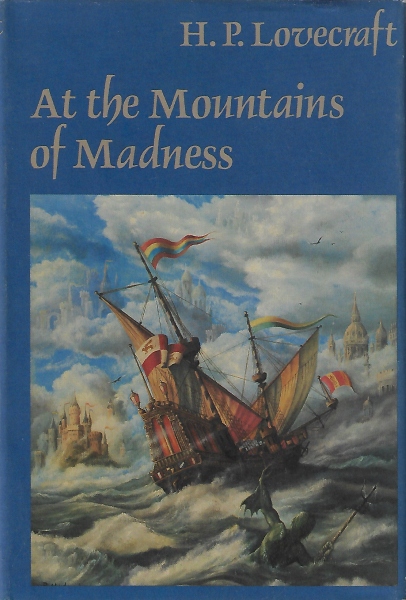
Lovecraft Covers

 The first time I saw H.P. Lovecraft's name was in an advertisement in Creepy Magazine for a series of books. I had no idea who he was or what he wrote, but the freakish looking covers by John Holmes were nuts. It would be several years before I read anything by him, but Holmes' covers stuck with me. I'd later end up picking up most of them along with almost any other Lovecraftian collection I could get my hands on. 

I'm on a bit of a Lovecraftian roll right now. I wrote about Lord Dunsany's At the Edge of the World for Tales from the Magician's Skull. That inspired me to pick up HPL's The Dream Quest of Unknown Kadath for the first time in ages. Simultaneously, to celebrate my shared birthday with HPL, I'm revisiting the very first collection of his stories I ever read; The Shadow Over Innsmouth and Other Stories of Horror published by Scholastic Books of all people. This leads me right to another display of Lovecraftian covers, so here you go.


These first two are August Derleth's Lovecraftian anthology, Tales of the Cthulhu Mythos (1969), broken into two parts. Alongside several Lovecraft originals, there are terrific stories by Robert Block, Brian Lumley, and Frank Belknap Long. Finding these two books at an early age (12 or 13), set me off on a hunt for as many Mythos writers as I could possibly get my hands on. 


Even in the beginning, I was less than fond of August Derleth's efforts at Mythos tale-telling. Not as poor as Lin Carter's, but he never really had the feel for the stuff. His best ones are those that eschew New England and use his own Midwestern environs instead and those aren't here.


These are the original Arkham house omnibuses of Lovecraft's fiction. With the first three covers by Lee Brown Coye and the last by Gahan Wilson, these are a pulp reader's delight. My local library had the first three (which still impresses the heck out of me!) and were the ones I always wanted to own myself. That was not to be. 


These 1980s covers by Raymond Bayless are the ones I ended up with on my shelves. I bought all four on my first book run to Providence back in the mid-nineties. They're fine enough, but a little too meh for my tastes. They do have S.T. Joshi's introductions and, as much as he can be irritating at times, these are incredibly valuable and more than worth your time.


Tony Patrick's covers are not to my taste at all. They appear to have been released around 2001. While they're the current versions, with the slowing collapse of Arkham House, I wonder if there'll ever be another series.


And here it is, where it all began for me on the night of the Great Blackout in 1977. While it's got some lesser tales, it also has The Colour Out of Space and The Shadow Over Innsmouth


Thursday, October 24, 2019

Five Horror Short Story Collections That Aren't My Favorites

Horror: (from the OED Online)
A painful emotion compounded of loathing and fear; a shuddering with terror and repugnance; strong aversion mingled with dread; the feeling excited by something shocking or frightful. Also in weaker sense, intense dislike or repugnance. (The prevalent use at all times.)
I strongly believe horror, as a genre, works best at the short story level. I've probably expounded on this before, but, wait, I'm going to again. It's a masterful novel that can maintain the suspense, fear, and atmosphere to deliver a good, unnerving chill to the marrow. Unfortunately, while I've read many very good horror novels (see this post), but, man, oh Manischewitz, I've read way more terrible, or just plain crappy, ones.

On the other hand, I've read great stories from mediocre novelists. Like a nightmare, a story only needs a little time to get in there and drive a spike into your brain or leach poison into your soul. No matter how lunatic the setup is, if it only last a dozen pages, it doesn't have to be able to hold up to deep scrutiny. If you want an evil, winking planet, you can do it ("The Tugging" by Ramsey Campbell). Short fiction is where the horror can run its freest and wildest.


In A Lonely Place (1983) by Karl Edward Wagner

It's been some time since I've read all of this nigh-perfect collection, but enough memories of the best stories in remain so I feel confident in writing about it. Wagner is probably best remembered as an editor of tremendous talent and a writer of topnotch swords & sorcery tales. What he also was, was a very, very good horror writer. If you don't believe me, just look up how many times "Where the Summer Ends" and "Sticks" have been anthologized. Wagner wrote more stories than the seven included in this volume, but these are the ones with which to start.


The Inhabitants of the Lake & Other Less Welcome Tenants (1964) by Ramsey Campbell
What can I say, I love this one, it's an absolute blast. Ramsey Campbell, one of the most respected names in horror, began, as most genre writers do, as a fan. Before he was a teenager, inspired by ghost stories he had read he turned his hand to writing his own. Later, as a teenager, he wrote Cthulhu Mythos tales that strove to be spitting images of HPL's own. At August Derleth's suggestion, Campbell rewrote them in an English setting. In 1964, at the age of eighteen, Arkham House published, Inhabitants, Campbell's first collection.

Replete with creepy, inbred denizens of spiritually corrupt towns, unwholesome tomes, and new Mythos deities of his own devising, these stories are an absolute hoot. Lin Carter tried to do the same thing in his Mythos stories, but they are mostly failures. I think the difference is, ultimately, even at a young age, Campbell was just a better writer and Carter never got that it was atmosphere more than demonic genealogies and lists of tomes that make these sort of stories work. Now, these stories are no great works of art, but Campbell knew for them to work their needed to be discomfiting, to be disturbing. The urban decay and moral rot that's a major part of Campbell's later, non-Mythos, writing can already be found in some of these early stories.


Owls Hoot in the Daytime and Other Omens (2003) by Manly Wade Wellman

This isn't the first and it probably won't be the last collection of Manly Wade Wellman's John the Balladeer stories, but it's the one I have. For those uninitiated to the wondrous magic of Wellman's yarns, these are essentially paranormal detective stories. Instead of fog-shrouded cities, they're set among the deep hollows and mountains of Appalachia and are filled with bits of real (and invented) rural folklore.

I have no memory of when I first encountered Wellman and his stories. It might have been the story "Owls Hoot in the Daytime" itself. It first appeared in Kirby McCauley's terrific anthology, Dark Forces, but I can't swear to it. However I found him, I became a fan years ago and find myself dipping back into his stories regularly. I like them all, but it's the John stories I find drawn back to most often.


Night Shift (1978) by Stephen King

What can I say except that this is the book, more than any other, which made me a lifelong Stephen King fan? I like many of his novels and collections, but the only one other than The Shining that I've read multiple times is this. I've read it maybe half a dozen times over the years, all at once or in bits and pieces. Including "Quitters, Inc.," "The Children of the Corn," and "Night Shift," this collects more of King's truly great stories than any of the other collections published over the years. Vampires, aliens, Lovecraftian horror, King leaves practically no horror stone unturned and it's a blast.

Looking at the table of contents, I was almost shocked at just how many of the stories in Night Shift have been filmed - eleven as standalone or parts of anthology films or tv-miniseries  and several more as non-professional shorts (the latter as part of a deal where King allowed student and amateur directors license stories for a dollar). Most of the films stink, but I'd be curious just how much King has profited from this single forty-one year old story collection. Whatever, if you aren't a King reader but are curious, this is still the best place to start.


Nocturnes (2004) by John Connolly

I discovered John Connolly through the Kevin Costner horror movie, The New Daughter (2009). The movie is not bad, if not great, still some things about it - the inevitability of its conclusion particularly - lodged themselves in my brain and wouldn't let go. When I discovered the movie was based on a story by someone named John Connolly, I decided to get a copy. A quick search brought me to Nocturnes. Since then, I've read nineteen books of Connolly's, seventeen of them part of a series, and not one has disappointed me.


From the King-like "The Cancer Cowboy Rides Again," to the MR James-like "Mr Pettinger's Dæmon," to the supernatural detective novella, "The Reflecting Eye." this book supplies all the chills and shudders I want from horror stories. Nine of the fifteen stories began as a radio scripts and that shows in their ghost-story-around-the-fireplace feel. I wrote a standalone post about the collection when I first found it that you can read HERE. I only describe the stories above as "like" King or James to give you a sense of what they're like. Connolly doesn't hide his influences, but he is not pasticheur. He writes with an authority and eloquence that verges into the poetic many, many times, and its all his own.

The best thing to come out of discovering Connolly was finding his series character, Charlie Parker. Again, I've written about the books HERE. I cannot recommend them enough.
***************************************

I could write a dozen posts about another sixty collections I've loved over the decades, but these five are among the very best and among the ones I've gone back to again and again. Not every story in any of them is perfect. Some are even bad, still each of these contains among some of the very best spooky writing from the last half century.

Tuesday, March 27, 2018

Ramsey Campbell Lovecraft Mythos

Everybody knows (or should know) the story of sixteen year old Ramsey Campbell submitting stories set in Lovecraft Country to August Derleth. Derleth sent them back suggesting he set them in his native England instead of alien New England. Thus Campbell's Sevren Valley was born. Instead of Arkham there's Brichester, for Innsmouth there's Goatswood, and for Kingsport, Temphill. 

The Chaosium published tribute to Campbell's Mythos fiction, Made in Goatswood has none of his early stories. I decided, in that case, I had better go and read them, first, for the fun of it, and then to get a better feel for what the collection authors' were hoping to emulate and memorialize. So, I'm also reading the latest edition of Campbell's first book, The Inhabitant of the Lake and Less Welcome Tenants.

The edition I have (2013, Drugstore Indian Press) includes an introduction by Campbell and his early correspondence with August Derleth. It's fun thinking of Derleth doing what Lovecraft did for him for Campbell. Derleth offered many suggestions that led to Campbell creating his own English setting and new deities for Mythos-inspired fiction. It's interesting to look at how Campbell turned out - one of the most important and revered horror writers - versus how Derleth did - a poor Mythos writer, but a solid editor.

If you haven't read Campbell's pastiches, they're clunky and more about monsters than atmosphere. Nonetheless, they are a bunch of fun. Some are only echoes of stories by HPL, but in others you can already sense his eventual predilection for grotty, urban unease forming.

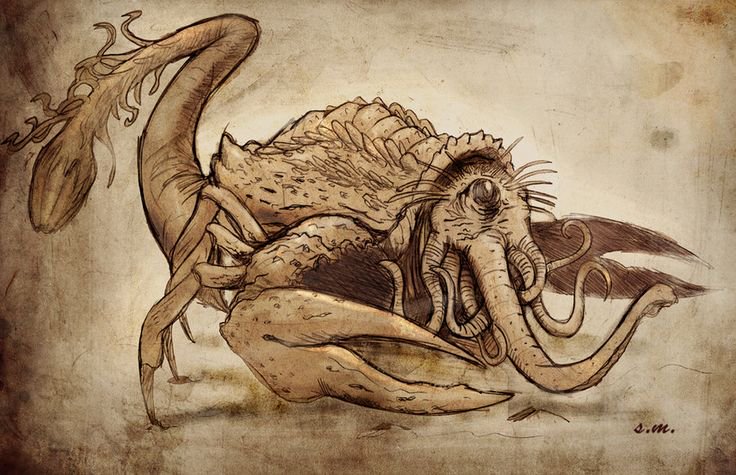
The best thing about them, though, has to be the monsters. They're more intimate than HPL's critters, and what they do to their victims more personal. Where Cthulhu or Yog-Sothoth's kid just step on you, Gla'aki and Eihort gut you up close and you can feel your life seeping away, torturous moment by torturous moment. So, today, I give you monster pictures.

Byatis: "It had but one eye like the Cyclops and had claws like unto a crab. He said also that it had a nose like the elephants...and great serpent-like growths which hung from its face like a beard in the fashion of some sea monster. .." 
from "The Room in the Castle"

Gla'aki: "The centre of each picture was, it was obvious, the being know as Gla'aki. From an oval body protruded countless thin, pointed spines of multicolored metal' at the more rounded end of the oval a circular, thick-lipped mouth formed the centre of a spongy face, from which rose three yellow eyes on thin stalks. Around the underside of the body were many white pyramids, presumably used for locomotion. The diameter of the body must have been about ten feet at its least width."
from "The Inhabitant of the Lake"


Eihort: "Then came pale movement in the well, and something clambered up from the dark, a bloated blanched oval supported on myriad fleshless legs. Eyes formed in the gelatinous oval and stared at him."
        from "Before the Storm"

Y'golonac: "He saw why the shadow on the frosted pane yesterday had been headless, and he screamed. As the desk was thrust aside by the towering naked  figure, on whose surface still hung rags of the tweed suit, Strutt’s last thought was an unbelieving conviction that this was happening because he had read the
Revelations…but before he could scream out his protest his breath was cut off, as the hands descended on his face and the wet red mouths opened in their palms."
        from "Cold Print"


Sunday, March 18, 2018

Creepy John Holmes Mythos Covers

Before I read my first Lovecraft story ("The Festival"), I had seen his books advertised on the back pages of Creepy and Eerie magazines. I had no idea what they were, but it was clear they were horror stories.


When I first picked up HPL, it wasn't in these editions, but an edition of The Shadow Over Innsmouth published by Scholastic Books. These Ballantine collections, though, were all over the place in the late seventies and were among the first I bought myself.

Looking over the contents, they leave out a lot of the major stories, and The Shuttered Room persists in claiming Derleth's stories are based on actual unfinished HPL stories and not mere fragments or jottings in his commonplace book. The two Cthulhu Mythos anthologies, originally released as a single hardcover volume edited by August Derleth, are great. Between them, you get some of the best Mythos fiction. There's "The Hounds of Tindalos," "The Black Stone," "Notebook Found in a Deserted House," and other really good stories.

So, take a moment and take a look at some of the wildest Lovecraft cover art from the late John Holmes.