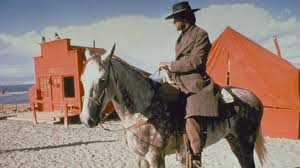
Can you tell I'm in the middle of a Western kick, 'cause I am. Like every obsession that I get caught up in, it came on me quickly and at some point it'll fade away as quickly. In the meantime, I'm going to get as much out of it as I can. Right now, I'm having a blast watching movies I've never seen and rewatching ones I already love.
There are two prominent reasons I like Westerns. If I sat down and talked with you I could pull a bunch more out for you, but the following two are the most significant.
First, like hard boiled crime stories or heroic fantasy, Westerns, at their best, are stories of men (mostly) living on the edge of society where civilization's rules are scant and but they have only their own code of honor, will, and strength to draw on in order to survive. That sort of story is one that calls to me across genres. Even in this faceless age, it makes me feel like there's hope to win out against the odds.

Second, I get a definite buzz of comforting nostalgia from the genre. I was introduced to the genre by my dad. He'd been reading and watching Westerns from childhood. Having grown up in the thirties and forties, the heyday of the Western movies, while I can't say he saw and read them all, it sure seemed like that. Watching them sends me back down the years and I picture myself, arms propped under my chin, lying on the floor and my dad sitting in his chair, both of our eyes glued to the TV and Jwatching ohn Wayne or Clint Eastwood save the day or gunning down the bad guys.

I never talked with my dad about Westerns as a genre, only as individual books or movies. I knew he loved Frank O'Rourke and Louis L'Amour and thought Zane Grey dated and thought Robert E. Howard's Western stories were just bad. With movies, in addition to Lonesome Dove, The Stalking Moon with Gregory Peck and A Fistful of Dollars and Stagecoach were ones he'd always leave on when they showed up.
Among the many boxes of books in the attic, my dad kept several full of Westerns. Max Brand, Frank O'Rourke, Louis L'amour, Ernest Haycox were only the most prominent. There were tons of others but at this point there names escape me. I can't just go look through them, though. When my dad got sick and a terminal diagnosis, he took the boxes to the book trader he'd been buying books from for decades. When he told me I was pissed. Just because I hadn't been interested in them didn't mean I would, I claimed. Then he told me that while he was talking with the owner, a little old man came in, exclaimed when he saw them, and bought most of them on the spot. I couldn't argue with that sort of reaction. In fact, I could only hope in my last days I could find someone who'd react that way to finding my books offered up for sale.
 The Shooting, (1966), dir. M.Hellman, writ. A. Joyce (C. Eastman)
Roger Corman gave many young film makers the chance to make nearly any movie that they could dream of, provided they could work to tight budgets and strict schedules. Out of this arrangement came some of very successful, artistically as well as commercially, directors, including John Sayles, Jonathan Demme, and Ron Howard. Another was Monte Hellman, who took the offer from Corman and instead of just making good drive-in movies, made some incredibly idiosyncratic films.
While probably best known for the road-race movie, Two-Lane Blacktop, in 1966, Hellman and Jack Nicholson, fresh from making two movies in the Philippines, Back Door to Hell and Flight to Fury, they went out into the Utah desert and made two of the most striking Westerns. The movies were shot back to back, first The Shooting, then Ride in the Whirlwind. Each was made for about $75,000, around $600,000 in today's money.
Ride in the Whirlwind, starring Jack Nicholson, Cameron Mitchell, and Millie Perkins is a dark story of mistaken identities and murder. More like one of Boetticher's bleak films than Ford's mythic ones; it's still clearly part of the Western tradition. There's a lynch-minded posse, bandits on the run and the innocent men mistaken for them.
The Shooting, on the other hand, is a like a nightmare, and its secrets remain hidden until the final frames. The characters are ciphers, to the viewer and to each other. Monte Hellman himself in an interview with Millie Perkins from 2014 admits exactly what happened to trigger the films events is a mystery that even he doesn't have an answer to.
Like its companion, it was shot out on a desert in Utah, but it looks it might as well have been shot on the moon. Save a few scenes in a mining camp and a town, the story unfolds on barren desert and stony hillsides. Other than the enigmatic characters and their mounts, nothing alive crosses the landscape.
The movie opens with Willett Gashade, played by the always-grizzled Warren Oates, returning to his mining camp. He seems to realize someone is following him and he deliberately leaves a trail to help them. Back in camp, his partner, Coley (Will Hutchins) opens fire on him from inside a cave.
It turns out another partner was murdered the other day by an unseen shooter. Before that, Willett's brother, Coin, had fled the camp. Something had happened in the nearby town and Coin might have accidentally trampled someone to death with his horse.
A short time later a mysterious woman appears. She has heard Willett's a good tracker and wants hire him to get her across the desert to the town of Kingsley. He agrees, but only if he can take Coley with. They set off right away. Later, a gunman, Billy Spear (Jack Nicholson), joins the trio. Exactly why he's there is unclear to Willett, but he's clearly been hired by the woman.
I won't say anything more plot wise about The Shooting. Hellman and Carole Eastman (credited as Adrien Joyce) created a film that was meant to be mysterious and stay that way. The whys and wherefores of certain things remain unclear all the way to the end.
Warren Oates was one of the greatest character actors of all times. That meant, even when relegated to the sidelines, your eyes will focus on him whenever he come on screen. In the all-too-few films he is the lead in, he is absolutely mesmerizing.
There's an unnerving watchfulness in his performance in The Shooting. As Willett, he seems to know the answers to all the film's questions, even the ones he's asking, and is waiting for some terrible resolution to come hammering down. He rides off with the woman fully aware of the calamities that lie out on the desert before him.
If Boetticher stripped away much of the romance of John Ford and others' version of the West, Hellman sands away even that. Boetticher's movies are still driven by recognizable human drama; The Shooting is like something by Beckett. The characters look recognizable, but every motive, every riddle's answer, lies hidden and the story takes place somewhere off to the side of reality.
Ride in the Whirlwind, starring Jack Nicholson, Cameron Mitchell, and Millie Perkins is a dark story of mistaken identities and murder. More like one of Boetticher's bleak films than Ford's mythic ones; it's still clearly part of the Western tradition. There's a lynch-minded posse, bandits on the run and the innocent men mistaken for them.
The Shooting, on the other hand, is a like a nightmare, and its secrets remain hidden until the final frames. The characters are ciphers, to the viewer and to each other. Monte Hellman himself in an interview with Millie Perkins from 2014 admits exactly what happened to trigger the films events is a mystery that even he doesn't have an answer to.
Like its companion, it was shot out on a desert in Utah, but it looks it might as well have been shot on the moon. Save a few scenes in a mining camp and a town, the story unfolds on barren desert and stony hillsides. Other than the enigmatic characters and their mounts, nothing alive crosses the landscape.
The movie opens with Willett Gashade, played by the always-grizzled Warren Oates, returning to his mining camp. He seems to realize someone is following him and he deliberately leaves a trail to help them. Back in camp, his partner, Coley (Will Hutchins) opens fire on him from inside a cave.
It turns out another partner was murdered the other day by an unseen shooter. Before that, Willett's brother, Coin, had fled the camp. Something had happened in the nearby town and Coin might have accidentally trampled someone to death with his horse.
A short time later a mysterious woman appears. She has heard Willett's a good tracker and wants hire him to get her across the desert to the town of Kingsley. He agrees, but only if he can take Coley with. They set off right away. Later, a gunman, Billy Spear (Jack Nicholson), joins the trio. Exactly why he's there is unclear to Willett, but he's clearly been hired by the woman.
I won't say anything more plot wise about The Shooting. Hellman and Carole Eastman (credited as Adrien Joyce) created a film that was meant to be mysterious and stay that way. The whys and wherefores of certain things remain unclear all the way to the end.
 |
| Millie Perkins |
There's an unnerving watchfulness in his performance in The Shooting. As Willett, he seems to know the answers to all the film's questions, even the ones he's asking, and is waiting for some terrible resolution to come hammering down. He rides off with the woman fully aware of the calamities that lie out on the desert before him.
If Boetticher stripped away much of the romance of John Ford and others' version of the West, Hellman sands away even that. Boetticher's movies are still driven by recognizable human drama; The Shooting is like something by Beckett. The characters look recognizable, but every motive, every riddle's answer, lies hidden and the story takes place somewhere off to the side of reality.
 |
| Jack Nicholson and Warren Oates |

Stagecoach (1939), dir. J. Ford, writ. D. Nichols
This is one of the first great Westerns. It also helped set in stone John Wayne's persona as a self-reliant, laconic, tough guy, and, arguably, playing the Ringo Kid, it's the movie that made him a super star.
Stagecoach is based on a short story, "The Stage to Lordsburg," by Ernest Haycox. A disparate band of travelers find themselves together on the titular vehicle. There's an attack by an improbably large number of Apaches, a hooker with a heart of gold, and a showdown. In other words, this movie is chock full of classic tropes, but here they're done with near absolute perfection.
Orson Welles claimed to have watched Stagecoach forty times in preparation for making Citizen Kane. I totally believe him. Ford knew how to shoot a movie. Every scene is perfect, whether out in the open spaces between the buttes of Monument Valley or in the cramped confines of the titular stagecoach.
Each character gets enough screen time and dialogue to feel alive instead of like a bundle of tics and mannerisms. There's the drunken doctor (Thomas Mitchell) and the hooker (Claire Trevor), both driven out of town at the movie's start, the cavalry officer's pregnant wife (Louise Platt), the marshal (George Bancroft), the thieving bank president (Berton Churchill), the mysterious gambler (John Carradine), the whisky salesman (Donald Meek), and the stagecoach driver (Andy Devine). Partway through their journey across the Apache-haunter desert, they're joined by the vengeance-driven gunman (Wayne). It may feel all too familiar to some modern viewers, but this is where these characters and the trope of them traveling together come from.
 |
| Claire Trevor and John Wayne |
Wayne got (and gets) a lot of grief for being a limited actor. I don't agree, but I do think he was happy to coast on the strength of his persona, something that he and Ford created in this picture. Here, in its earliest manifestation, it's powerful. Wayne's Ringo Kid is driven to avenge his murdered father and brother and, later, to dismiss social conventions when he falls hard for Trevor's Dallas. He's tall, striking, and when that distinct voice rolls out of him there's still a bit of a shiver that goes up my spine.
If Stagecoach has escaped your attention somehow go right now to YouTube and watch it in its entirety. Now!
 |
| Trevor, Wayne, Devine, Carradine, Platt, Mitchell, Churchill, Meek, and Bancroft |

The Great Silence (1968), dir. S. Corbucci, writ. S.Corbucci, B.Corbucci, M. Amendola, V. Petrilli
Inspired by the deaths of revolutionaries Che Guevara and Malcolm X, and a major inspiration for Quentin Tarantino's Hateful 8, The Great Silence is recognized as Italian director Sergio Corbucci's masterpiece. Most so-called revisionist Westerns are really just grittier versions of the same sorts of stories the genre had always told. This isn't just some subversion of the old stories but a total rejection of them. Supposedly, when Daryl Zanuck saw how it ended he refused to give it an American distribution. Even if you disagree with Corbucci's politics, there's no denying the emotional power they invest in The Great Silence.
Filmed in the snow-covered Dolomite Mountains of Italy and with a soundtrack by Ennio Morricone, The Great Silence is a beautiful and stark. Against the great fields of white, characters look tiny and insignificant.
Spaghetti Westerns often look and feel more dreamlike than real. Despite being more naturalistic than many others, Corbucci's film bears down like a relentless nightmare, where the world remains forever unbearably cold and its denizens trapped in privation.
French actor Jean-Louis Trintignant is Silence. As a boy he witnessed the murder of his parents. To keep him from telling on them, one of the killers cuts his throat, leaving him mute. Years later, he's become a gunslinger who makes his way in the world by provoking his opponents to draw first then shooting them.
Settlers turn to thieving when a terrible blizzard settles on the Utah town of Snow Hill and the surrounding region. In retaliation, wealthy landowner Henry Pollicutt, the same man behind the murder of Silence's parents, hires the mad bounty hunter Loco to kill them.
 |
| Klaus Kinski |
Played by the nearly ineffable Klaus Kinski, Loco is a jittery psychopath who is also one of the deadliest gunmen around. His performance suffers from it being dubbed in during post-production, but it's still one of his best.
The first time I saw this I had no idea what I was in for. All these years later I can still recall the shock I felt vividly. Repeated watchings haven't dimmed the power of the film, instead, they let me focus on its entirety, not just the surprising parts. Fifty years old now, it still hits like a metal hammer between the eyes.
 |
| Jean-Louis Trintignant as Silence |

Despite being based on a book by segregationist and Klansman, Forrest Carter, Clint Eastwood's The Outlaw Josey Wales is one of the most humanistic Westerns I've ever seen. A man who was unable to save his family goes on to form sort of a new one with Indians, pro-Union settlers, and the rag tag citizens of a dying frontier town.
Josey Wales, a Missouri farmer, survives an attack by pro-Union guerillas that leaves his wife and son dead. To avenge them he joins up with Bloody Bill Anderson's pro-Confederate guerillas. When the war ends and the amnesty the guerillas is offered turns out to be a trick in order to kill them, Wales and the young Jamie survive and take off for the Indian Territory (modern Oklahoma).
With a price on his head, Wales begins a series of adventures that will end in a bloody showdown in a small town in Texas.
 |
| Chief Dan George |
I like a lot of Clint Eastwood Westerns, but this is my favorite. It's got a satisfying mix of heavy and light. The hilarious Chief Dan George steals every scene he's in as the Lone Watie, a Cherokee chief. The action scenes are tough and exciting. The movie never loses energy. Despite its mostly episodic nature there's a real momentum to the central story that Eastwood never lets flag.
I've never found Eastwood an especially memorable director visually, but he excels at telling stories and bringing characters to life. He does that better in The Outlaw Josey Wales than in any of the other Westerns he directed.
He also recreates the world of the post-Civil War frontier, depicting both its dangers and the promise it offered. There's hopefulness to the movie that ultimately outweighs its darker parts. An encounter between Wales and the Comanche chief really drives home a sort of pragmatic optimism that the world can be better than it is. I won't write anymore because if you've somehow managed to miss this you I don't want give anything away.