Showing posts sorted by relevance for query attic. Sort by date Show all posts

Saturday, April 5, 2014

Books From My Dad - Douglas C. Jones

My dad was tremendous reader, the sort of person who usually had three or four books going at a given time. His tastes included sci-fi and fantasy, crime and mystery, history and westerns. Half the books I read as as a kid I got from him. For whatever reason, I just never took to the westerns. I've said before I love western movies, but I never developed a taste for the books.

He suggested I read The Shotgun Man by Frank O'Rourke. I did and remember absolutely nothing about it. On my own, many years later, I read Larry McMurty's Lonesome Dove series. As much as I love McMurty's books it didn't make me pick up any other westerns.

My dad had several boxes of westerns up in the attic. I looked through them but nothing held my eye. I remember some of the authors and covers to this day; Ernest Haycox, Frank O'Rourke, Louis L'amour, being those that come to mind first.

An author he only discovered later in life was Douglas C. Jones. My boss was going to throw away a box of books but I rescued them. I took them home, showed them to my dad, and Winding Stair by Jones caught his eye. As soon as he finished it he asked me to keep my eyes open for anything else by him. Within a year or so he had amassed a stack of Jones' books.

Jones was born in Arkansas and spent almost thirty years in the army. When he retired from the service he started writing. His first published novel was alternate-history The Court-Martial of George Armstrong Custer (which was made into a tv-movie). He was fascinated with the Arkansas-Indian Territory frontier that still existed barely a generation before he was born in 1924. Many of his books are set there or feature protagonists raised there. 


When my dad got sick  (cancer, terminal, miserable) he took the boxes of westerns and gave them to the used book store he had been going to for over twenty years. He figured I wouldn't read them and wanted a little less clutter in the attic for my mom to deal with after he was gone (my dad's family is about as Wasp as can be so even in the face of death there's a need to be practical). While he was talking to the owner a little old man came in and took the lot. While part of me was annoyed for giving any books away, I knew there couldn't be a better end for a bunch of books than that.

But he didn't include the Douglas C. Jones books in those boxes and I don't know why. I don't know if he read all of them, though I suspect he did. After he died the books have sat in a box in the attic for the past dozen years.

Recent posts by Howard Andrew Jones and comments by several people have turned my eyes to western fiction again. Remembering the box of Jones books I retreived them and figure I'll start where my dad did; with Winding Stair.

Monday, November 26, 2012

More (Moorcock) Covers That Awed Me.

   So many of the books I read as a kid I discovered in cardboard boxes my dad kept in the attic (eleven years after his death most of the paperbacks we essentially co-owned are still there).  I can't remember at what age I started dipping into those boxes but I can remember the feeling of wonder I got when I did.  From Asimov to Zelazny with all stops in between.  There were (are) probably thousands of books in those ancient boxes.  Rockets and wild aliens or brooding swordsmen and bat-winged monsters overhead held the promise of excitement and adventure.  At an early artists like Kelly Freas, and Vincent Di Fate were helping shape my imagination's landscape.
   Like so many readers, I suspect, when presented with a slew of unfamiliar books, we grab the one with the cover that grabs us first.  I don't do that much anymore, but in my youth, boy, oh, boy is that what I did.  Two of the strangest covers I found in the attic were for Lancer Book's Elric books; "The Dreaming City" and "The Sleeping Sorceress".


   These covers, a vibrant collision of psychedelic colors and a weird, almost rotoscope effect were like nothing else (well, maybe the whacked out Ballantine "Lord of the Rings" covers) in the attic.  First there's the girl with the Medusa hair on "Dreaming City" and then the one with the multi-hued afro on "Sleeping Sorceress" to catch your eyes.  Both are staring straight at the reader with alien eyes and arms and wrists held in odd, unnatural poses.  I doubt the dusky-skinned Elric matches anyone's imagined Elric but he and his dragon-winged helmet still demands your attention.  The rainbow plumage of the the winged skull on "Sleeping Sorceress" is beautiful.  The strangeness of the covers turned out to be a perfect match for Moorcock's strange, off-kilter S&S.
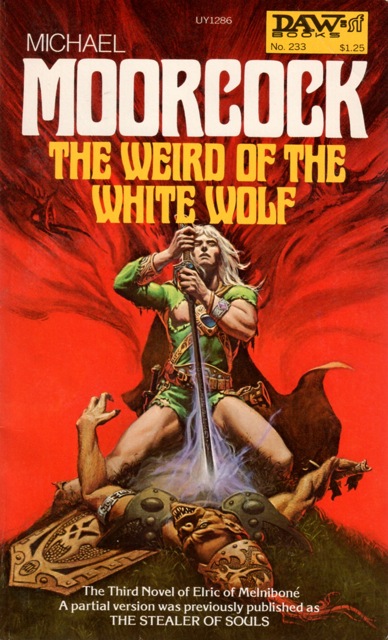
   Fortunately I started reading Elric at the same time DAW started publishing them.  Several trips to Paperback Booksmith in the Staten Island Mall rewarded me with all six original novels.  Michael Whelan's cover art is some of the best in the genre, striving for realistic characters set in believable, fantastic surroundings.  Five of the covers are great (let's all agree the pig-faced corpse ruins "The Weird of the White Wolf").  It's the final one, "Stormbringer", that is a monster.  I don't love the pteranodon dragon in the corner, but, dang, that's a fine, over the top and side-of-the-van worthy Elric.  Stormbringer overhead and Horn of Fate trailing behind, Elric's charging head on at the reader with a perfectly psychotic glint in his bloody red eyes.  I didn't know the apocalyptic story awaiting me inside that book but its cover portended dangerous craziness.  


   I am a little sad that in this day and age of e-books I don't care about covers as much.  I'm not buying in used-book stores, let alone Barnes & Noble, like I used to so the eyecatching ability isn't that relevant.  I know what I'm buying ahead of time with almost every book purchase these days.  I've read the reviews, gotten the recommendations and heard the podcast with the author.  It's the same thing with music.  I can barely recognize the covers of the last MP3 album I bought but the cover of my friend's brother's copy of "In the Court of the Crimson King" is still seared into my mind.  
   I love my e-books and I don't miss the feel of a book and turning pages.  That's because it's the words that I hold dear.  But I will miss the art, and I believe the day's coming when it will pass away into the e-ink ether, one more lost element of analog times.

Friday, February 14, 2014

Cool Covers for Books I Never Read


   So these books run a very high risk of stinking but I remain curious. The thing is, my dad was as big a fan as any one could be of Carter's books and had these two in one of those attic boxes I alway mention. and they always caught my eye. The Black Star is probably one of my favorite Frazetta pictures. I've got a lot of stuff I'm hoping to get to this year but I think I need to pull these out of the attic and put them on the TBR stack.


Saturday, September 10, 2016

Sci-fi Covers From My Youth

There were certain books in the boxes my dad kept in the attic that always caught my eye. These covers still hold places of honor burned deeply in to my hippocampus. Some are realistic, others impressionistic. Whichever they are, they helped form my vision of what sci-fi should look like. The aliens, spaceships, and heroes of my imagination had their roots in cover art as much as in the words behind the covers. Here are some of my favorite.


With barely a hint of what's inside other than something weird and mysterious, these three covers by Don Punchatz for the original Foundation trilogy were more than enough to entice me to pick them up. More than now, as a kid I picked up books based on cover art. The stark two-color schemes and cartoonish characters made these books look strange and alien - exactly what 12-year old me wanted in science fiction. I haven't read these in nearly twenty years, but I remember the clunky dialogue and outdated science did nothing to detract from their appeal. Asimov's idea - history as manipulatable math problems - is still big and just ridiculous enough to be cool. One reason I read so little modern sci-fi is that it just seems small.


Kelly Freas was one of the greatest sci-fi artists of all time. Just follow this link and look at his work to see what I mean. Lots of my dad's books had wilder Freas covers, but these are the ones I remember most.

The austere looking on Soldier, Ask Not with star and starship behind his shoulder still strikes me as the perfect mil-sci-fi picture. Dressed in utilitarian black uniform, dark circles under his eyes, and a brooding look on his face, he seems resigned to whatever calamitous event he's about to suffer. I didn't read the book for ages even though I'd read Dorsai! and Tactics of Mistake years earlier. It's been ages, which I suspect haven't been overly kind to the series, but Soldier was the best volume.

There's no doubt the man on the cover of Tactics is a hero, a man of destiny. Dickson's character, Cletus Grahame, is exactly that. A military genius, he lays the groundwork for the mercenaries of the planet Dorsai to become something other than just dedicated fighters, but instead galactic super soldiers, bred from the womb to combat perfection. Even thirty-five years ago, I thought the book was a too pat and Grahame's ideas worked way too well too often. Man, though, Freas' painting is awe-inspiring, like some New Soviet man or Fascist hero from the thirties, daring the future to thwart him. Probably exactly NOT what Dickson wanted you to think.


Dune and Dune Messiah came out in the sixties, so they were already in the attic by the time at eight or nine when I started rooting around for books to read. Children of Dune came out when I was ten and it must have been huge, because I even saw it in the spinners at the A&P. Three different artists, three different styles, all amazing, all etched in my brain.

John Schoenherr's cover of Dune imprinted itself on me only after I read the book. Which I did in a single, long day when I fourteen or so, the first time I'd ever done something like that. From practically the first page, Herbert's eco-themed space opera and its teenaged hero, grabbed and shook me hard. I still hold that it's one of the greatest works of sci-fi and that it didn't need any sequels.

I probably reread it three or four times before reading Dune Messiah and Children of Dune in my thirties. Once I read the book, that's the cover stuck with me. Under a huge outcrop, a small string of Fremen cross the endless desert of Arrakis. There are other covers, even one to by Vincent Di Fate to match Children, but whenever I think of the Arrakis, it looks like that.

Dune Messiah's  cover by Jack Gaughan is just freaky. I think it's supposed to be the tomb where Paul Atreides buried the skull of his father, Duke Leto,  but there was no way for me to know that before reading it. Instead, it was just some bizarre, giant head rising out of the sands for no apparent reason. I guess I just assumed it was some sort of spooky memorial to Paul. It's a tremendously striking cover that would never pass muster with these days.

Taking a much more realistic approach, Vincent Di Fate applied his sharp-edged style for the cover of Children of Dune. Pretty much mimicking the orange tones of Gaughan's art, Di Fate's Arrakis looks even harsher than Shoenherr's vision of Dune. Thinking back, probably because of its ubiquity, this is one of the first sci-fi covers I can really remember seeing. Di Fate's spaceships decorate tons of books I've read over the decades and I love their long, clean lines. While there isn't one of his iconic rockets here, on Children,  the red sky and skyline, composed of razor-sharp lines, feels pure sci-fi to me, and I love it. As much as I like wild cover art like on the Foundation books, I also like sleek realism.

Not only do I not like many modern covers, but reading mostly e-book, I don't even really see covers much anymore. Just for a second after I open the kindle app and before I click open the book file, and then it's gone. New books don't sit on my desk, cover face up burning its artist's impression of them on me. Since I don't have space for more physical books, I guess it's okay. As someone raised on the work of artists like Kelly Freas and Richard Powers it's just one more part of my past lost.

Thursday, March 9, 2017

Books My Dad Read (and read, and read, and read)

Without my dad, my tastes in science fiction and fantasy wouldn't be what they are. It was he who had boxes of paperbacks in the attic filled with Poul Anderson, Gordon Dickson, Fred Saberhagen, and the like. They were added to constantly as he snagged new books at the Staten Island Ferry Terminal in Manhattan or Waldenbooks. Together we took regular trips to local used bookstores, where he'd usually pick up an armful of books.

The thing is, as I grew up, our tastes diverged. Not completely, but significantly. Since he read so much, finishing several books a week, he deplenish his stock of new stuff and turn back and reread certain old ones over and over again. These are the ones I know he read at least five times or more. 


I never read Roland Green's Wandor or Vance's Alastor Cluster books. For some inexplicable reason the Wandor books looked to cheesy. I mean, when he brought those home, there wasn't much heroic fantasy he brought home that I just did pick up when he was done. I have no idea whatsover I saw in these that made me not do that. The little bit I've found out about them, they sound like they're filled with carboard characters and a list of plot coupons to punched and foozles to be defeated. As for the Vance books, well, I've got no excuse. Somehow, I never found the time for them despite all together they don't break 650 pages. Sheesh.

My memories of the Stasheff and Lanier books are fond, but I suspect there's a heavy blanket of nostalgia laid over them. The Stasheff series eventually topped out at a dozen books, but I never read any mention of them anymore. They're humorous stories of a secret agent landing on a planet with a medieval tech level and magic. I'd be willing to reread the first one, but probably no more than that.

Lanier's books, with psionic heroes, mutants animals, secret societies, and deadly, atom-spawned abominations was the primary source for TSR's GAMMA WORLD. I've read some negative reviews recently, but I'm still tempted to go back to them.

Patterns of Chaos was solid, pulp fun. A man with no memories finds himself on a planet targeted for destruction by "hell-burner" missles. Then people start talking to him in his head. I'd love to find my dad's copy and give it a go. I think he might have reread this a dozen times of more.

Finally, a book that looks way cooler than any memory I have of it. I think The Yngling is about a Scandinavian warrior in a post-apocalyptic world saving the day. There were several sequels and I know my dad read them as well, if not as often. As a kid I found it lackluster and would be hard-pressed to think about revisiting it.

My dad liked his sci-fi and fantasy boisterous and pulpy. He saved contemplation for when he read history. I first read Karl Edward Wagner and Robert E. Howard because of him. Same for Tolkien. Early Jack Williamson and Edmond Hamilton came to me via those boxes in the attic as well. 


If a book was too soft-sciency or grungy or whatever, he probably wasn't going to bother with it. Early on, I fell in love with Clifford D. Simak's stories, but they never caught my dad. I don't think he finished William Gibson's Neuromancer of Howard Waldrop's Them Bones when I suggested he read them. On the other hand, he became enthralled by David Wingrove's bizarre Chung Kuo series. Whatever the case, if the local librarian Ms. Herz really made me a reader, it was my dad who made me a reader of sci-fi and fantasy. It's one of the many things I'm eternally grateful to my dad for.


Saturday, November 5, 2011

The Spell of Witch World - An Unknown Land


Andre Norton's Witch World books are another series I've avoided for way too long. There were two things that kept me away from them over the years. The first, when I was younger, was their name: Witch World. It seemed a little too twee. When I was older there were just too many other things I wanted to read that it just never crossed my mind to investigate Andre Norton's catalogue. If she ever occurred to me at all it was as the author of Starman's Son and several other books shelved in the children's section at my local library.  Later I found a few scattered Norton volumes in the boxes of paperbacks my dad kept in the attic but, again, nothing prompted me to read them. At the time the cover of "Witch World" turned me off (today I love the goofy looking thing).

   Not until I started contemplating this blog did I actually read anything by Andre Norton. There were several anthologies I had never managed to buy copies of until the last two years, one being "Flashing Swords #2", edited by Lin Carter.  I had read some of its stories before but not "The Toads of Grimmerdale" set in Norton's Witch World.
   I was surprised by the darkness of the story.  Like I said, I had assumed the Witch World stuff was light and airy and my first encounter with it was a story of revenge for rape set in a country savaged by years of war.  Well, I was hooked.


   I quickly read "Spider Silk" in Flashing Swords #3 and "Falcon Blood" in Amazons!, edited by Jessica Amanda Salmonson. I finally rooted through boxes in my sister's attic and dug out my dad's ancient copy of the first novel, Witch World, and devoured it. Its inventiveness, fast pacing and the sheer fun of it made me an instant fan.

  Finding a new author amid the endless shelves of crap is a one of the great joys in my life. That Andre Norton had left a fairly large supply of Witch World books for the newcomer was exciting. That it might fit in with the ideas I was playing with for what would become "Swords & Sorcery" was an added bonus. Very cool.
   Spell of the Witch World is the seventh book published in the Witch World series. It contains three stories set in High Hallack, a region on the western continent of a world where magic sits beside super science and mind powers.  One of the major events in High Hallack is a brutal war with a nation from across the sea that drags on for years and results in dislocation of peoples and an upsetting of the pre-war order.  The first story, "Dragon Scale Silver" takes place just before and during the early stages of the the war.  The second, "Dream Smith" occurs long before it and the final tale, "Amber Out of Quayth" takes place after its conclusion.
   "Dragon Scale Silver" is the story of Elys and her birth as a refugee from the east and her training as both spell caster and swordswoman.  Born to castaways fleeing war across the sea on the eastern continent, Elys and her twin brother Elyn, are raised and trained in the fishing village of Wark.  Both children are trained to war by their father but Elys, taking after her mother, is also trained in the ways of understanding and using magic.
   When war begins, Elyn longs to go off and fight.  Not until after the presumed death of his father does he.  Elys remains with the villagers and later shepherds them to safety in distant valleys.  Despite the protection and help she provides them with they never view her as one of their own.  She is an alien and a wielder of unnatural powers.
   Despite her separation from Elyn, Elys maintains a magical tie to him through deep magic conjured up and created by her mother in the form of a dragon scale silver chalice.  When it darkens she knows he is in some sort of grave danger she sets off to rescue him.
   Elys is accompanied on her mission by Jervon, a High Hallack warrior who wandered into her people's settlement wounded from battle.  After his recovery he is clearly smitten by Elyn, and unlike the villagers, he is not particularly discomforted by her talents and abilities.  He is willing to put himself at risk in order to provide her aid and support.
   Reaching her brother's keep, Elys finds he has married and her sister-in-law is no more at ease around her than the villagers were.  He is also missing having fallen subject to a curse of the Old One laying on the castle.  With sword, spells and a ferocious will, Elys wades into the danger.
  "Dream Smith" reads much like a fairy tale.  Collard, one of a smith's sons, is crippled and disfigured to a hideous degree by an explosion caused by a strange ore.  Only later is it learned that it probably comes from a some lost cache of the Old Ones.  He is so malformed that he must wear a mask to even walk about in his village.  
  The explosion also leaves Collard with strange and powerful dreams.  When he wakes from them he is able to craft the creatures from his dreams and cast them in the remaining pieces of the metal that damaged him.
   Collard soon becomes acquainted with and enthralled by the young and sickly noblewoman, Jacinda.  She is sent to the village because her father's new wife claims she can not conceive a "straight son" if she even sees "such a twisted, crooked body."
   Fascinated by someone he senses might be a kindred spirit he sends her gifts of some of his dream creations.  Overcoming his fear and self loathing he eventually meets her and their fates become entwined.
   The last tale, "Amber Out of Quayth" is pretty much a traditional Gothic tale.  To more or less quote the late Donald Westlake, "A gothic is a story about a girl who gets a house".  
   Ysmay, the daughter of the late lord of Uppsdale loses her place as chatelaine of the house when her brother comes home from war with a wife.  Uppsdale is a poor place and with little hope of being able to provide a dowry Ysmay believes she's condemned to a hopeless life of loneliness and no authority over how she lives it.  All this changes when a fair brings Ysmay's household into contact with Hylle, a lord and craftsman from an unknown land in the far north.  
   Uppsdale's wealth had been built on a rich supply of amber but an unmovable rockslide destroyed access to it.  Hylle, who works strange and beautiful crafts from amber, claims to have a way to free the vein of wealth.  In exchange for asks for half the supply and the hand of Ysmay in marriage.
   While Hylle is strange the prospect of escape proves strong to Ysmay.  She willing accepts the offer much to the joy of her brother and sister-in-law.  Soon they are wed and headed north to places beyond Ysmay's knowledge.
   Hylle's home, Ysmay, learns, is an ancient castle.  She quickly learns that she will be left to her own devices.  Hylle promptly tells her he will be gone on many journeys related to his alchemical studies and he will only be her husband in name, not in any other way.  He also tells her there is one tower she must never enter.  Which of course she does.
   I loved these stories.  By themselves they are well wrought but as part of the tapestry of Witch World they are amazing.
   In the single short novel and ten stories I've read I've encountered a detailed and textured world with more color and character than any number of doorstopper fantasy novels I've wasted time on.  Taking place in different eras the stories create a true history containing numerous presents.
   Witch World is a at once familiar, with medieval keeps and  development, yet filled with wondrous strangeness.  We hear of ancient races and suffer the effects imprinted on the world by their long ago presence.  War washes over the land and displaces people who don't even know why the war is happening.  There is folk magic and high magic and both operate differently and serve different purposes.
  Witch World is also one of much sadness.  It is not unbearable sadness but instead the steady debilitating kind that comes from onslaught of custom and daily hardships.  Women are constrained by the need to marry well and poor ones face spinsterhood and purposelessness.  Common people are driven out time and time again by war and suffer from their own countrymen turned brigand.
  And still there is happiness.  Strength of soul is rewarded and goodness prospers.  It often comes after anguish and suffering but it never seems unwarranted.
   You might argue about my inclusion of Andre Norton among the ranks of swords & sorcery writers.  Well, tough.  "Dragon Scale Silver" has swords AND sorcery and Norton was a member of Lin Carter's SAGA (Swordsmen and Sorcerers' Guild of America) back in the genre's first great revival forty years ago.  
   Honestly, Witch World is a legitimate part of the genre.  There is swordplay and thrown spells aplenty alongside transdimensional portals and submarines.  As concerned as they are with the interiors of their protagonists and the thoughts behind the decisions they make their is derring-do, harsh violence and powerful sorcery.
   Check it out.  They're all available fairly cheap on Amazon so spend the lucre and give them a shot.

Tuesday, March 20, 2018

Chaosium Mythos Covers and the Chaosium Mythos Fiction Project


   I'm not sure if I'll ever complete my Chaosium Mythos Fiction Project, something I abandoned after only four posts (not counting an early non-project review I did of the The Scroll of Thoth). Even though I made it to the most excellent Mysteries of the Worm by Robert Bloch, struggling through the most execrable The Xothic Cycle by Lin Carter knocked the wind and the snot out of me. 

   Still, they those books, all 33 of them, call to me, chillingly, enticingly, from their place on the top shelf, every now and then as I walk past them to the attic. I hear their papery whispers summoning to pull them down and peruse secrets man was not meant to know. To once again hear the Dhol Chants, wander the streets of Ulthar, and spy upon the towers of Y'ha-nthlei beneath the ocean's waves. You know, the normal stuff books do.


   Lately, as I've been listening to a podcast about HPL, those voices from above have pulled with a little more vigor. Some of the collections are really very good, especially the ones inspired by Ramsey Campbell and Brian Lumley's Mythos stories. There's a lot of dross between some of those covers, but there's also some really top-grade stuff, some of it by people no one's ever heard of. I'd really like to go back to the project, but we'll have to see what happens.

   Robert Price and all the other editors did a really good job scouring the world for great stories. A lot of the bad stuff, especially in Price's volumes arises from the desire to present a complete history of Mythos fiction, meaning whether you want it or not, August Derleth's and Lin Carter's stories get included. Like 'em or not, they're important to the development of Mythos fiction as its own genre. 

   It doesn't just stop there, though. Price in particular was intent on using the collection he put together to explore Lovecraft's fiction as part of a greater context that stretches before and after his stories. For an full example of what I mean, read the post on The Hastur Cycle. Price includes writing from Ambrose Bierce, Arthur Machen, and Robert Chambers and shows exactly where some of HPL's ideas and names came from. I don't agree with everything he says, but in the scheme of Mythos fiction, they're important collections and his arguments bear listening to.

1. Chaosium's Mythos Fiction 11/9/2014 
2. Chaosium Mythos Fiction: Have You Seen the Yellow Sign? : The Hastur Cycle, edited

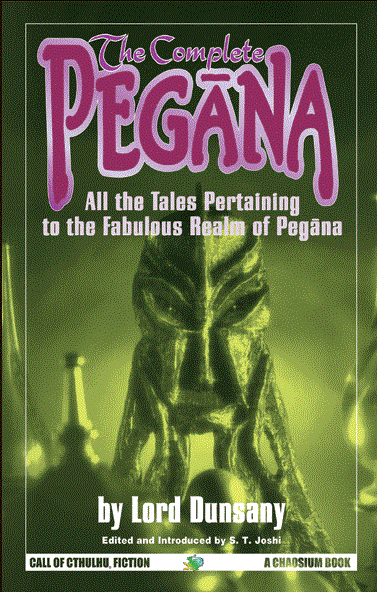
The Covers: The early releases' covers were by Dreyfus, aka Andrew Caines. They're not bad, but not anything we haven't seen before. They made the books look more like gaming supplements than fiction.  

It was with the later edition covers by H. E. Fassl that the series took on a distinctive look. I don't know what techniques he employed. It looks like he sculpted sets and figures and made dioramas he then photographed. The sculpted pieces remind me of Clark Ashton Smith's creations. However he did them, they possess an eerie, organic quality that is deeply weird. They're a far cry from the pulpiness of the first covers or the later one. Instead, Fassl's work looks to the surrealness of Mythos fiction. Funny enough, though, my favorite is one that doesn't appear to be a diorama: Nameless Cults. Just what the heck is that screaming mouth mounted on, an egg? Very, very freaky. It's a shame they weren't able to have him do all the covers and give the entire series a unified, and very particular look.