Thursday, March 31, 2016

Prelude to The Wake by Paul Kingsnorth

I finished Paul Kingsnorth's The Wake and am in the middle of writing about it for my next Black Gate post. For those of you who haven't heard of it, it's about Buccmaster of Holland, a wealthy farmer from Lincolnshire, who takes to the fens and woods as a green man bent on fighting the Norman conquerors.  He is by turns a liar, a patriot, a guerilla, and a murderer, and Kingsnorth's writing makes him the most riveting narrator I've read of late. It's also one of the most penetrating  psychological studies of a man under devastating pressure.
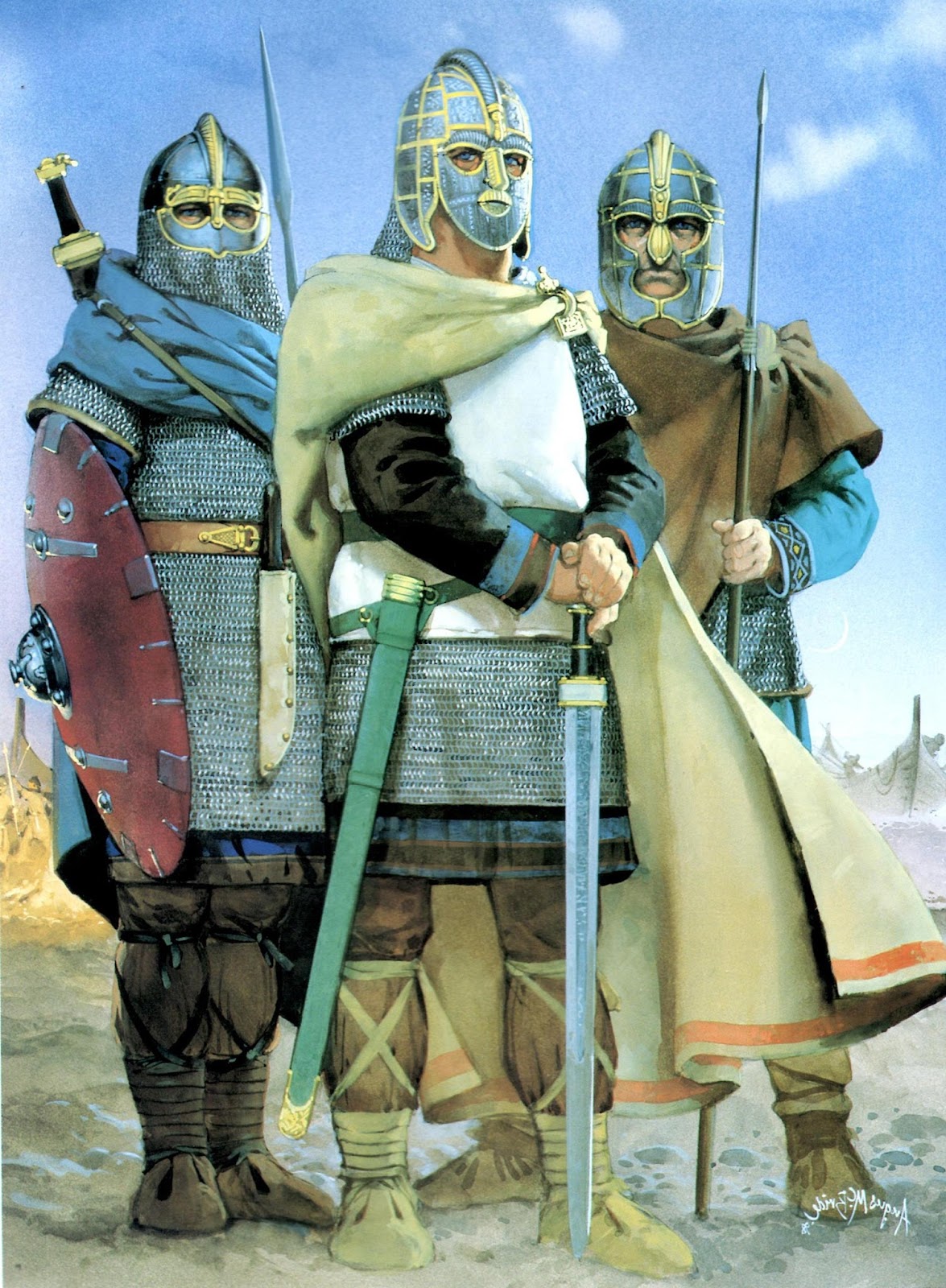
Saxon thegns
Buccmaster tells his own story in an invented vernacular Kingsnorth calls a shadow language. It's built on Old and contemporary English and doesn't allow words without pre-Norman origins or letters not in Old English, like K and Q. It's tough to read for the first page or two, but soon, like me, you'll probably find yourself reading it out loud, letting the odd rhythm overtake you as it becomes more natural. Slowly, the language permeates you, letting you see the world from Buccmaster's ancient perspective, not your own.

Saxon England is more violent, from hearth and home up to national affairs. People are also closer than us to the natural world as most people make their livings off it, most as farmers, others as fishermen or charcoal burners or hunters.

large Saxon house
One of the major themes Buccmaster hits on again and again, is of the past being a better time than the present. The near past, just prior to the Norman invasion was better because then he was rich and locally important. He had men who owed him service each week and he held a seat on the wapentake (an administrative body).

The deeper past, half a millennium back, when the Saxons first arrived, was better because men were bolder and held true to the old ways, following Wodan and his ilk, not Christ. Now all is lost. 

Battle of Hastings
The thing is, the past Buccmaster longs for is a mythical one with more roots in legend than reality. Reading background material for my review, I've come to learn the reality of the Saxon settlement of England and the subsequent birth of England is far more complex than I used to believe. Recent studies of English DNA show that the old idea that the native Britons were driven into Wales and Cornwall and supplanted by the Angles, Saxons, and Jutes, are not wholly accurate.


Germanic DNA only composes 25% to 40% of the average white Briton's genetic makeup. The Romans and the Danes seem to have come purely as conquerors, leaving next to no genetic traces among contemporary Britons. The northern Welsh seem to be the "purest" remnants of the pre-Saxon, Celtic population, while the rest of the Celts are more different from each other than they are from the English. 

The present theory is that it was in the best interest of conquered Britons to take up the habits and culture of the invading Germans. The weregild for a murdered Briton was much less than that of a German. There seem to have been privileges attached to speaking German instead of Brittonic.  

Mitochondrial evidence shows that the Celtic DNA is largely maternal while the German paternal. This had led some to theorize a sexual apartheid existed in early England, leaving British men out in the cold when it came to reproduction. 

Researchers also expected to find a similar genetic heritage among the Celts of Britain, the Cornish, Welsh, Scots, and Irish. They didn't.

Prof Mark Robinson, an archaeologist who works with Prof Donnelly at Oxford University, said he was "very surprised" that Celtic groups in Cornwall, Wales, Northern Ireland and Scotland had such different genetic patterns.
"I had assumed at the very early stages of the project that there was going to be this uniform Celtic fringe extending from Cornwall through to Wales into Scotland. And this has very definitely not been the case," he told BBC News.
The researchers did see distinct genetic groups within those regions but those groups were quite different from each other, according to Prof Donnelly.
"Although people from Cornwall have a Celtic heritage, genetically they are much, much more similar to the people elsewhere in England than they are to the Welsh for example," said Prof Donnelly.
"People in South Wales are also quite different genetically to people in north Wales, who are both different in turn to the Scots. We did not find a single genetic group corresponding to the Celtic traditions in the western fringes of Britain."
from the BBC 

The history of Britain through 1066 is one of invasions and cultural conquest. The original stone age people were conquered by bronze-using tribes from the West (the subject of Treece's The Golden Strangers). The Celts did the same thing when they arrived. By the time Caesar landed in Britain, everyone on the island was a Celt. The Germans did the same thing in turn. That the Normans, themselves descendants of Vikings who'd invaded northern France, did it is no surprise. 
Normans on the beach


Several reviews of The Wake call it a post-apocalyptic story. To an extent, it is. Saxon society, flawed as it might look to us, was stable, with each man knowing his place in it. When it's destroyed, all Hell is let loose. Men like Buccmaster, who refuse to submit, lose everything. The book gives us hints of the devastation caused by William during the Harrowing of the North. Buccmaster and his band skulking across the landscape spying on their Norman conquerors is reminiscent of H.G. Wells' narrator watching the Martians impose their will on England. The Saxons, though, don't get saved. 

The Wake is a book that I know I will reread over the coming years. It is a powerful meditation on identity and cultural loss. Kingsnorth's shadow language is something, I suspect, needs to be immersed in again and again to be truly appreciated. It's a brilliant book that's worthy of all the praise and accolades given it. If you haven't read it yet, I strongly recommend you do.

Tuesday, March 1, 2016

Cool Things That Caught My Eye

Like the title says; interesting articles/posts to read or things to spend money on that caught my eye this week.

First: The Viking Trilogy by Henry Treece - In the comments over at Jim Cornelius' Frontier Partisans in a discussion of the Dark Mountain Project (among other things), I mentioned author Henry Treece and his Celtic Quartet (I've reviewed The Dark Island, Red Queen,White Queen, and The Great Captains at Black Gate) and how I want to read his Viking Trilogy, but it's hard to come by.

Well, no longer. Tooling around Amazon to see how much it would cost to get paperbacks of some of Treece's books, I saw a pre-release notice for YA The Viking Trilogy on kindle coming in July. I will buy it the moment it's available and am hoping it's a portent of a widespread release of Treece's work in e-format.

Treece started as a poet and a founder of a short-lived school of writing called the New Apocalyptics. He and his fellow Apocalyptics believed that poetry had become stale and too focused on realism. Reading through a 43-year old Ph.D. theses, I learned Treece put together a manifesto with four points:


1) That Man was in need of greater freedom, economic no less than aesthetic, from machine and mechanistic thinking.
2) That no existent political system, Left or Right; no artistic ideology, Surrealism or the political school of Auden, was able to provide this freedom.
3) That the Machine Age had exerted too strong an influence on art, and had prevented the individual development of Man.
4) That Myth, as a personal means of reintegrating the personality, had been neglected and despised.

I've never read any of his poetry, but I can see elements of the manifesto in his historical novels. The three I've read are set all set in bloody hinge moments of British history. They are also set on the edge of realism and the supernatural. Some events are clearly supernatural while others All three depict points of rupture in the old order, when the world its characters have assumed would continue forever is destroyed. In each, the beauty of the land, its mystery, is the set against destruction and death. Order falls to chaos and the world moves in a new, unforeseen direction. 

I only have one more to read in the quartet, The Golden Strangers. It's set in Britain's distant past when tribes with bronze weapons arrive to the detriment of the island's less advanced natives.

Second: A History of Violence - Tom Breihan of the AV Club has started a series on the history of modern action movies. For each year he picks what he considers the best film. He also discusses briefly several other genre movies from the year in question. So far it's been a smart, insightful series that's already got me trying to track down two movies I haven't seen in a long time. I hope he manages to stick with this long enough to chronicle the evolution from the more tough-guy movies of the seventies thru the pumped up eighties of Schwarzenegger and Stallone to the hyperactive present. 

For reasons he explains and I'm willing to go along with, he starts with 1968's Bullitt. For those who haven't seen it, it stars Steve McQueen in one of his most iconic roles and features one of the first great modern car chases. 

For those raised on the hyper-kineticism of modern action scenes, it may be a little slow, but the chase is a model of automotive choreography and editing. Unlike most modern action films, it has a fairly complex and involved plot and some actual characterization. 

His 1969 choice is Sam Peckinpah's blood-drenched masterpiece, The Wild Bunch. It stars William Holden, Robert Ryan, Ernest Borgnine, Warren Oates, and Ben Johnson.  If you haven't seen this and have any interest in Westerns, action movies, or just plain old great movie making, you should see this.


Finally, for 1970 Breihan chose The Chinese Boxer starring Jimmy Wang Yu. Before this he starred in classic, One-Armed Swordsman, its sequel, Golden Swallow, and several others. I'll have to see if I can get a copy. 


He says the movie is considered the first pure martial arts movie, focusing on hand-to-hand fighting and choreography.  I haven't seen this one in years and have almost no memory of it, but Wang is one of the martial arts movie greats. 

It should be fun to see what Breihan choose in the weeks to come. If you have an interest in action films, this should be a weekly stop for you.


Thursday, February 18, 2016

Mailbag: Christmasbooksapalooza!

I went nuts this past Christmas spending all my money on a stack of virtual books that, much as I would love to, I know I won't finish this year. It is a nice assortment of fiction and non-fiction. Only one's a book I've read before and several are by authors I haven't read yet all.


This is the sequel to the wonderful Goblin Moon (which I reviewed at Black Gate). I already have it, by its original title, The Gnome's Engine, in paperback, but this is cheap and has a couple of short stories set in the same universe.


Another volume of Langdon St. Ives' adventures from one of the creators of steampunk.


I like Stoddard's site a lot and I figured, since I just bought The High House, why not buy the rest? 


More spooky short stories from the author of the good and brutal Charlie Parker spooky crime novels.


A novella from the best American horror writer. The blurb on the back, referring to assassin schools in the Himalayas and a space probe "accidentally" launched into a wormhole were enough to make me hit the "buy now" button.


Keene writer gonzo horror, Charles Rutledge recommends it, and with that cover how long could I really hold off buying it?


I've become interested in 18th and 19th century nautical warfare, so this looked to be a good intro. So far, it's very good.


Napoleon's Vietnam. Bloody, vicious grind for six years, that led the Corsican to call it the "Spanish Ulcer," as it cause a steady erosion of his resources and prestige.


A conflict I'm fascinated by and have never found a book that adequately untangles its complexities for me. At times both a war over real religious beliefs and over which power would hold sway over Germany. A terrible war with consequences that effected Europe for centuries.

Saturday, February 13, 2016

EPIC: Some Last Notes on The First Chronicles of Thomas Covenant

After nearly forty years of not reading them, I've finally finished The First Chronicles of Thomas Covenant. I tried to read Lord Foul's Bane a couple of time back in my youth, but Covenant's character and Donaldson's prose threw me off. They're still hard to handle, but the reward is rich and worth the work, something younger me couldn't be bothered with.

If I haven't been clear enough in my three Black Gate reviews, these books are great and powerful. If you haven't read them, you should. You will by turns be disgusted with, hate, and rage at Thomas Covenant. As Sarah Avery commented, when she first read, them she wanted to throw them against the wall multiple times. If you stick with them, though, you will encounter storytelling of scope and power rarely seen in genre fantasy, especially these days.

Somehow, the Castalia House blog picked up the review of The Illearth War as part of their "Pink Slime Watch." The implication is that it's the sort of weak, derivative fantasy that proliferated in the post-Shannara days and seriously lessened the overall quality of the genre. Tom 

I'm a big fan of the Castalia blog. Jeffro's Appendix N articles are stellar, and I really like the wargame articles. But to lump Donaldson in with Terry Brooks, and all the crap that flowed downward after him is just plain wrong. Putting Thomas Covenant alongside Drizzzzzzzt implies a lack of actual familiarity with these books. These books are complex, adult explorations of guilt, redemption, and heroism (among other things), using the fantasy genre to make the story operatic, MYTHICAL. And without giving anything away, Donaldson comes down pretty strongly on the side of taking action and being a hero. He just wants to point out those things can come with a steep price. 


John R. Fultz commented the other day on my Black Gate review of The Illearth War that:

In a very real way, Donaldson’s humanizing of Tolkien’s basic themes set the tone for the gritty, realism-drenched fantasies of today.
I think that's a true statement, but sadly the doors were opened for far more bad books than good ones. I'm not going to rehash the grimdark wars again, but so much of the fiction being peddled as such is just an excuse to drape easy cynicism and ultra-violence in a mantle of worldy insight into the miserable reality of life, the universe, and everything. 

Creating a world of gray and gray morality filled with characters hued in wondrous shades of gray is no deep insight. Personally, I think it's a childish one that should only sound insightful to a college freshman. There's nothing gray in Thomas Covenant's world. His world, in fact, it's a pretty black and white one, it's just that even good actions can have terrible consequences. It's a much more nuanced and realistic vision, something missing in most of today's supposedly more "realistic" fantasy. 

Finally, for anyone who has read these books I can't stress enough about checking out Fantasy Bedtime Hour. For nearly five years, two women, in bed, read, puzzled over, and created wonderfully low-rent recreations of Lord Foul's Bane. Each episode also feature conversations with experts. The last two episodes' expert is none other than Donaldson himself. I haven't watched them all yet, but the ones I have are priceless.

Wednesday, January 27, 2016

Mr. K's Used Books, Music, and More

The luminous Mrs. V. and I just finished a whirlwind road tour of the Deep South (NY to St. Augustine to New Orleans to Vicksburg to Charleston to back home). The last thing we did before beginning what was supposed to be a ten hour plus drive straight through to Staten Island from Charleston, we stopped at Mr. K's Used Books. Wow, I didn't think places like this existed.

Here in NYC, even the paperback book traders are pretty much all gone. Skyrocketing rents and the competition from online sellers and e-books did them in. And, truth be told, most of them aren't too much of a loss. The really good used books stores were far off in Providence and distant parts of New Jersey. Anyone who ever tells you how great the Strand is isn't a person who buys genre books. The store's selection is pretty poor.

Mr. K's is a bookstore dream come true. Its selection in every genre is large and fairly comprehensive. While newer books tend to predominate, each section (especially mysteries) has a decent selection of older books. And the prices are great. Norton Critical Editions (books I pick up used whenever I come across decent copies) sell for $6 and under, a very good price. The prices I saw on mass market editions ranged from as little as $1.50 to $5 for rarer paperback originals. Hardcovers looked to priced the same way.

And, as the title implies, they don't only sell used books. They have a huge selection of CDs, and DVDs. The place is huge to the point of being overwhelming, which is great. 

And despite all my praise, I only made a few purchases (while Mrs. V. picked up a stack of decorating and art books, and mysteries). But what purchases they were. And I only found one of them, my wife found the others.

Mrs. V. spotted both the three-disc The Sabata Trilogy and Lin Carter's Imaginary Worlds. The first was on a shelf of new arrivals and the second was shelved in the literary criticism.

The last thing I got was on a whim. I was skimming the Political Thriller section when the Len Deighton books caught my eye. I've only read a couple of his books (the searing Bomber and the Hitler-Wins-thriller SS-GB), but I've always meant to read The Ipcress File. And now I've got a nice copy for under two bucks. Even if it stinks, who cares?

And that's what I most loved about the old days roaming around used book stores. Of course I wanted to find that perfect (and underpriced) copy of a Ballantine Adult Fantasy book, but it was taking a chance on something completely new. That's a lot harder now and I'm probably never going to spend money on a brand new book without a real serious recommendation from someone I really trust. In the past, I could go to the Book Pit in Red Bank, NJ, and fill up a shopping bag of horror books with cool covers, mysteries that looked nicely off-kilter, and all sorts of classic sci-fi I had never gotten around to reading.


So, if you have the chance, check out Mr. K's. They also have several other locations: Greenville, SC, Asheville, NC, and Johnson City and Oak Ridge, TN. If you get the chance, definitely stop in.

Thursday, January 7, 2016

More Worlds Fantastic and Strange


A few years ago I wrote a piece titled Worlds Fantastic and Strange fantasy maps. Just this past Tuesday, I wrote a sequel over at Black Gate called Guides to Worlds Fantastic and Strange with more ruminations on maps at the front of fantasy books. 

The thing about maps and fantasy is there's an endless supply of them, at least it seems that way. So, here's a bunch of especially good ones.

**********************************************************************

P.C. Hodgell's maps of Rathilien. Hodgell's an artist from a family of artists. Her maps are clean and elegant, with attractive fonts for the titles. There are also detailed 3-d style maps of various buildings in many of the books as well. Good stuff. 


**********************************************************************

Pauline Baynes, illustrator of the Narnia books, also ended up doing artwork for several of Tolkien's books. She did gorgeous maps of both author's worlds. Both of these would make wonderful wall posters (hey, that's an idea).


**********************************************************************

Drawn by Cliff Bird for REHupa #34 in 1978, I wish this map of Charles Saunder's Nyumbani had an outline of modern Africa behind it just like the one of Hyboria. Alas, it doesn't, and we just have to enjoy it for what it is: a guide to Imaro's travels. If that's not good enough for you, I've got nothing else to say.


Saturday, January 2, 2016

Last Year and This Year

This past year was a haphazard one here at Swords & Sorcery: A Blog. First I tried to review all of Chaosium's Cthluhu Mythos anthologies, but Lin Carter killed that for me. Really, it was just too much of too much of the same stuff over and over again. To get to the really good stories I had to wade through lots of meh, to lousy, to hair-torn-out-at-the-roots bad stories. So after only a few volumes that whole business crashed and burned.


Then, in reaction to reading nothing but fantasy and being driven nuts by the state of the nation and the world, I turned to the Long 19th Century Project. While it crashed and burned as well, I will still go back to it. 


The rise of Western Imperialism and its attendant wars is one of the most compelling and interesting periods of world history. The great powers of today, save China, were forged into their modern versions during this era: industrialized America and Japan, Germany and Italy both united, Russia's completion of its southward and westward expansion, England and France chopping up Africa. 

My problem was I went overboard, trying to cram a vast stack of of books into my brain too quickly. I will definitely return to this in the coming year, just not with as concentrated attention, probably no more than a book or two at a time, but I will return.

Finally, there was, and still is, EPIC. It's going to be around at least until I finish the several series I've already started reviewing: First Chronicles of Thomas Covenant, Riddle-Master of Hed, and Fionavar. I need to read the next Kencyrath book from P.C. Hodgell, To Ride A Rathorn. Heck, I might even throw another Shanarra book in just for the heck of it. If I can think of anymore good stand-alones like Red Moon and Black Mountain I read/review them as well.

Then there are the reviews I've been asked to do (or will be shortly). The next Charles Saunders book should show up soon (oh, yeah!), a Gonji collection. Some other things I don't even know what they are yet.

And, as I've been doing for several years now, my short story reviews. I really don't read much new fantasy except in bite-size form, which suits me just fine. I get to read a wider array of authors, styles, and encounter dozens more ideas in a stack of doorstoppers. 

I do read a few books, mostly by people I know now, but very little of the popular stuff the kids are digging. With their terrible photo-realistic covers and their monstrous thickness and endless sequels, they just don't catch my eye. I need to read from people whose taste run similar to mine that a new book's good for me to chance it. I'm turning fifty this year, so I'm allowed to be crotchety.

And, of course, other posts about things that catch my fancy. Genre related things just not necessarily about a specific book or story, though they could be. You know, whatever.

I hope nobody got too bored or frustrated with my rapidly changing interests here during the last year. I like to believe I'm providing decent value (or amusement) for your dollar. I hope everyone sticks with me for the next twelve months. I don't know what it'll really bring, but I'm still having fun here and at Black Gate, so I with any luck that'll be apparent in what I write. Here's hoping, and a Happy New Year to everybody!